Vendor Selection Criteria for AI Engagements Scoped to a Single Asset-Side Process
Prove operational fit to your actual data before signing any vendor contract.
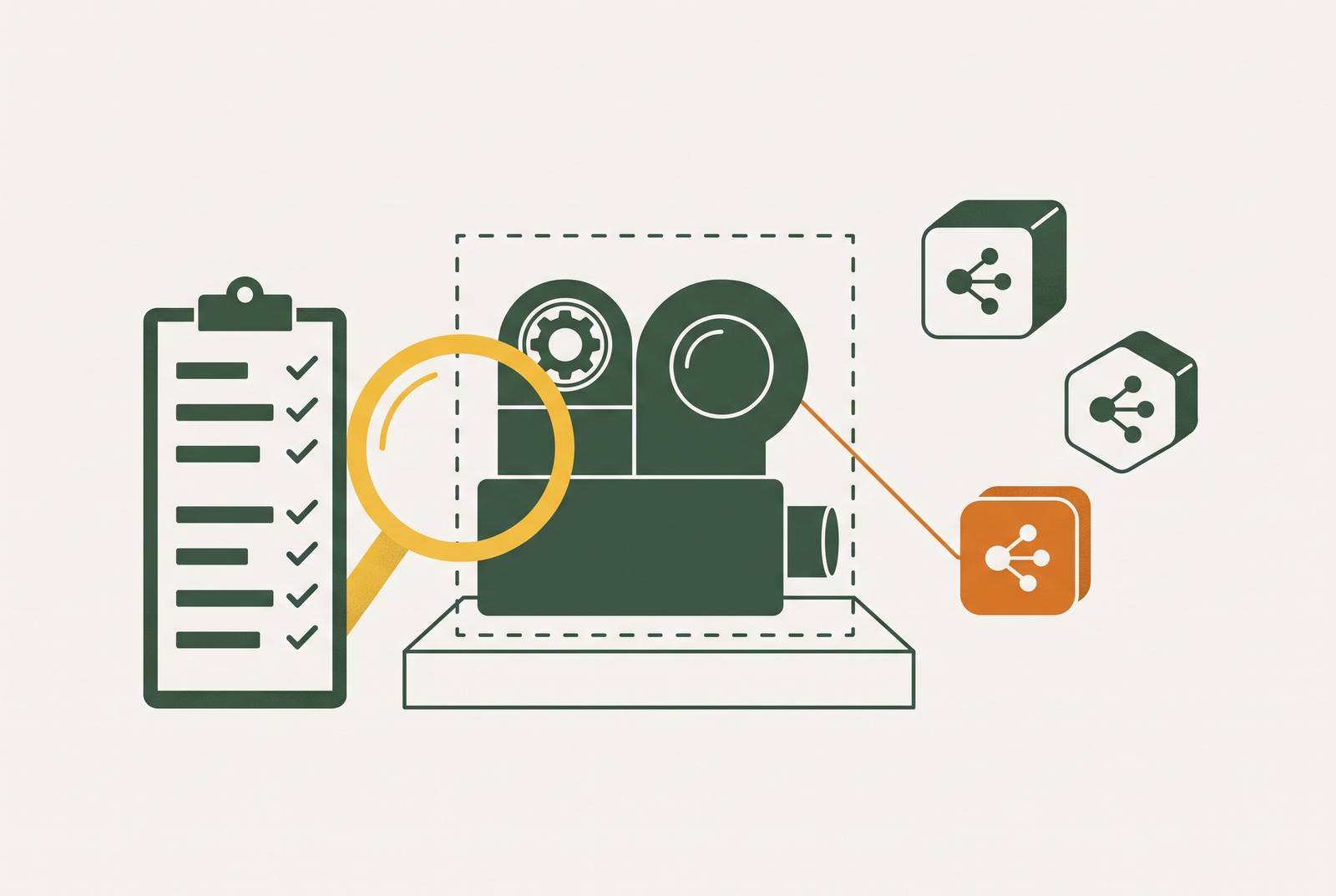
AI operations transformation for asset-heavy industries can start with one broken process, without a platform strategy or an enterprise digital roadmap. Vendor selection for that engagement should begin with a process audit and require proof on the buyer’s own data against a defined operational outcome. The deciding criterion is fit to the process, including its handoffs and failure boundaries.
Why generic vendor evaluation frameworks fail when scope locks to one process
The selection criteria that work for a platform purchase can actively mislead when scope is tight. Feature-checkbox RFPs, scripted demos, and analyst quadrant positioning compare broad capabilities, but they do not establish whether a system fits a procurement workflow or an energization readiness checklist. Breadth can conceal a weak operational fit.
That mismatch reflects how broad enterprise evaluations reward vendors. A controlled demo uses clean data, follows a narrow happy path, and shows scenarios that the seller chose. These conditions show what the tool can do while hiding the difficult process dependencies. The dominant failure pattern is workflow irrelevance. A stronger model does not repair a missing approval handoff or make an output useful to an owner who cannot act on it.
How do you fix one operations process without buying a whole platform?
Scoping the engagement to one use case, one owner, and one measurable outcome removes the promise of value elsewhere as a substitute for performance here. The vendor must show how its capability fits an actual sequence of work. Scope becomes a selection instrument. It forces the discussion toward what starts the task, what information supports it, and what decision follows.
Before making a shortlist of vendors, the buyer must map that sequence from start to finish. The map records where data originates, where model output goes, who approves it, and which systems need updates. It also specifies what happens when the model is uncertain or wrong. A vendor that pivots from these questions to platform breadth, roadmap vision, or unrelated reference customers has left the central requirement unanswered.
The demo problem and why proof of concept on your own data is the only real signal
A demo demonstrates performance under conditions selected to make the product work. It does not establish how the system behaves on messy production data, who maintains it, or what the workflow becomes on a difficult day. Those are features of the operating model being purchased. Buying the demo therefore substitutes evidence of presentation quality for evidence of operational fit.
Public-dataset benchmarks do not close that gap because vendors can optimize for those datasets. Asset-side evaluation instead depends on the buyer’s own production data and conditions standardized by the buyer. A proof of concept must use the domain’s difficult records as well as its tidy examples. Fragmented sources, conflicting document timestamps, and approval chains with handoff gaps are part of the test. Excluding them removes the conditions most likely to expose how a capable tool can fail to support a usable process.
The minimum requirement for moving beyond the demo is therefore a proof of concept on actual process data. Its purpose is not simply to produce a convincing output. Data readiness and organizational dependencies must become visible before contracting. A successful demonstration on sanitized records cannot establish that those dependencies have been resolved.
The five vendor behavior signals that expose real process fit before the pilot ends
Signal one. Scope narrowing. A vendor demonstrates process discipline by narrowing its response to the stated use case. Adjacent capabilities do not answer the immediate question. Expansion into a broader platform promise is a warning that the vendor has not yet established fit to the target process.
Signal two. Data honesty before architecture. A vendor that knows the process asks early about data quality, format, completeness, and provenance. It is candid when the data is not ready. Architecture discussions cannot resolve an unanswered question about whether the required information exists. If those questions go unanswered, integration will reveal a dependency after the buyer has already put in work.
Signal three. Buyer effort quantified. The implementation plan should itemize what the buyer’s team must do as well as what the vendor will deliver. Internal dependencies belong in the estimate from the start. A plan that covers only the vendor’s work leaves readiness for implementation untested and makes the work look easier than it is. The criterion is whether the buyer can see its own obligations clearly enough to judge feasibility.
Signal four. A process-native success metric and a go/no-go gate. The vendor should agree to both before the pilot begins. The outcome must belong to the process. Suitable measures include a reconciliation cycle shortened, a procurement conflict flagged before it propagates, or a readiness status verified against a defined checklist. Happy users alone do not prove that the process works, and refusing to agree on a decision point lets the sales push, rather than evidence, drive the purchase.
Signal five. Failure mode disclosure without being pressed. A production-ready vendor explains how the system fails, what happens when it is uncertain, and what fallback workflow applies. The boundaries must match the system’s autonomy. In multi-agent deployments, disclosure must also address isolation between agents because a procurement error can propagate into scheduling and logistics. A vendor that describes only successful outputs has not demonstrated how the process remains manageable when those outputs are wrong.
Why construction and energization readiness are the clearest test cases for these criteria
Construction exposes the gap between what documents declare and what the process can actually deliver. Poor schedule data limits what AI can contribute, while hallucinated dependencies and fabricated durations can make a forecast misleading. Explainability is an operational requirement. Without it, an owner cannot defend an AI-generated forecast in an extension-of-time claim, a stage-gate review, or a board paper. These are direct tests of data honesty and failure disclosure.
A Suffolk and MIT white paper estimates that several AI-enabled workflow changes used together could materially reduce project costs and compress schedules against a large completed project. One process cannot be treated as an island. Selecting for a single workflow still requires testing its adjacent handoffs, rather than using tight scope as a reason to ignore them.
Energization readiness makes that dependency especially concrete. Delivery lead times for critical electrical gear, including transformers, switchgear, and circuit breakers, have stretched from under three years before 2020 to as long as five years today. These components represent a small fraction of total data center construction cost but form the last gate before anything else can be energized. Procurement assumptions therefore become schedule constraints. A declared readiness status is insufficient if its supporting delivery assumptions conflict.
AI-assisted procurement auditing has a specific test here. If one document states switchgear delivery at 52 weeks and another states 78 weeks, the system should flag the discrepancy. The system must compare the lead times that vendors state with utility assumptions and project schedules. Assumptions hidden in PDFs can make the schedule model unreliable. Process fit means surfacing that conflict on the buyer’s actual procurement records.
How the same criteria apply across manufacturing, logistics, and retail asset-side processes
Manufacturing requires fit to a factory’s products, processes, equipment, workforce, suppliers, and operating constraints. Procter & Gamble, in collaboration with OMP’s Unison Planning™, streamlined 35 processes down to 20 through touchless, AI-enabled planning. It also created two planning roles, supply flow analyst and supply flow engineer, centered more on decisions requiring human intervention and less on data manipulation. The change reached the work itself. Although this example used a platform, its relevance to a narrow engagement is the depth of process redesign.
Hormel’s rollout of AI planning across more than 70 dry and refrigerated sites provides an example of workflow redesign. A vendor in a narrow logistics engagement must show how the proposed capability fits the selected process, even at a smaller scale.
Ulta Beauty expanded ship-from-store to roughly twice as many stores while keeping its core fulfillment footprint the same size. Across these sectors, the common unit of improvement is a process with specific data and decision handoffs. At those handoffs, it can also be unclear who has authority. That makes governance part of fit during selection.
Governance and failure boundary requirements that belong in the vendor evaluation, not the post-deployment review
Gartner predicts that a significant share of enterprises will demote or decommission autonomous AI agents because of governance gaps identified only after production incidents. Deferring those questions leaves discoverable weaknesses inside the deployment. The evaluation must establish boundaries before operational authority is granted. A polished demo does not prove that those boundaries are in place.
To test governance gaps, the evaluator can ask whether the vendor can demonstrate how agent access and action are bounded to the target process. To test transparency, the question is whether a reviewer can reconstruct a contested decision from an audit trail. These are different tests of operational control. One concerns what the system is allowed to do, while the other concerns whether its actions can be defended afterward. Both are necessary for a mission-critical workflow.
To test coordination, the evaluator must also ask what condition triggers a handoff between agents or steps. Safety requires asking how external document inputs are validated before reaching the reasoning layer, particularly where procurement and scheduling depend on material from many sources. To probe plateaued improvement, the evaluator can ask how the process integration would absorb new model capability rather than leave the workflow unchanged despite upgrades.
Data residency, retention, and access control also belong in the early evaluation. They are week-one filters. Autonomy levels require distinct failure boundaries as well. A vendor unable to explain these controls is not ready for a mission-critical process, regardless of its demo performance. Discovering the gap after deployment does not make it an unforeseeable operational accident.
The process audit as the starting point that makes vendor selection answerable
These criteria depend on the buyer documenting how the process runs today, including deviations from how it is supposed to run. The monthly financial close example illustrates the difference. A global manufacturing company purchased an off-the-shelf close automation tool that delivered dashboards but did not resolve the underlying reconciliation problem. The problem lived in the process. Selecting the tool first left the decisive source of failure outside the purchase decision.
The right sequence is process audit first, then vendor selection. The audit produces a clear statement of what the process does and where it fails, a data quality assessment, and a success metric grounded in operational reality. Each output supports a different selection test. The process statement defines fit, the data assessment establishes whether a vendor can add value immediately, and the metric makes the go/no-go decision answerable without relying on vendor-suggested KPIs.
Information captured as work happens strengthens that foundation because it reveals how and why decisions were made. Fragmented records assembled afterward provide a weaker basis for understanding the process the AI must support. The audit is therefore the selection instrument behind the other criteria. Without it, the buyer cannot distinguish a vendor that fits the operation from one that presents it convincingly, and the demo becomes the decision criterion again.