Evaluating AI Vendors on Process Depth Rather Than Platform Breadth in Manufacturing Operations
Focus vendor selection on solving your broken process, not counting platform features.
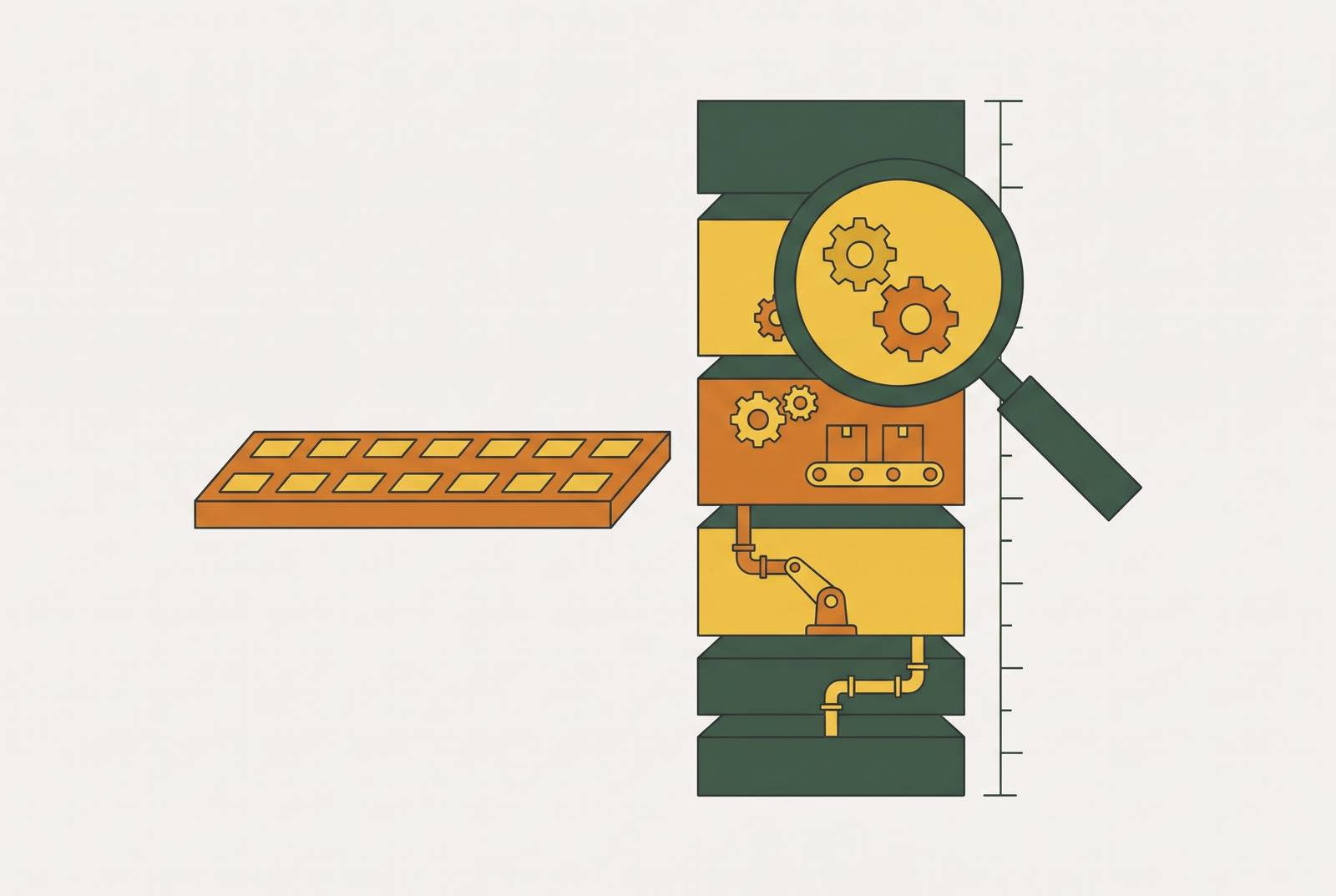
Manufacturing AI evaluation should start with one broken operational process. The strongest selection criterion is process depth, meaning whether a vendor understands that workflow well enough to rebuild it under production conditions. For asset-heavy industries without a digital roadmap, the practical starting point is a process audit followed by an evaluation of comparable production evidence, integration capability, and operational governance.
Why manufacturing AI vendor evaluations are built to fail before the contract is signed
The mismatch becomes clear well into deployment. A buyer who selected an impressive demonstration discovers that delivery depends on conditions the evaluation never tested. The vendor must work with the plant’s data, integrate with existing systems, and accommodate operational constraints that were absent from the presentation. By then, the contract is already signed.
Buyers issue an RFP, receive proposals, schedule demos, score performance, and select a vendor. That approach tests feature availability more readily than deployment quality, which depends on whether the vendor can build, integrate, govern, and scale a system in the buyer’s environment. The distinction is fundamental to manufacturing AI procurement.
A demo gives the vendor control over the data, environment, and capabilities shown. Production removes those advantages. When buyers give controlled demonstrations more weight than production evidence and reference calls, they reward a good presentation without checking whether the vendor can deliver. The evaluation fails before deployment because it asks the wrong evidence to predict the result.
What "platform breadth" actually signals and why it dominates evaluations
Platform breadth signals functional coverage. A platform may offer quality inspection, predictive maintenance, scheduling, and connected workforce capabilities without showing how well it can address the buyer’s specific constraint. Its strongest demonstration may come from whichever function performs most convincingly on curated data. That is evidence of a capability.
Breadth persists because vendor positioning and buyer scoring reinforce each other. Vendors say their many capabilities meet a wide range of needs, and scorecards give points for the number of functional categories they cover. The wider offering accumulates advantages even when those additional functions do not address the plant’s immediate problem.
The corrective is to define the constraint before reviewing proposals. A buyer should identify what needs to improve, whether defect escape rate, unplanned downtime, scheduling responsiveness, or operator error, and establish evaluation weights in advance. Otherwise, an attractive demonstration can quietly change what the buyer values.
What process depth means in a manufacturing context and why it predicts production success
Process depth is the ability to understand a manufacturing workflow well enough to change how it operates. Automation and redesign are not interchangeable. If a process already produces rework, speeding it up can spread that failure. A vendor with process depth can explain what needs to change before automation can help.
That understanding has concrete technical and operational boundaries. The Purdue Model constrains OT/IT integration, while regulated manufacturing introduces FDA or ISO documentation requirements. A proposed architecture that ignores OT security can require renegotiation after signing. A delivery plan that overlooks compliance documentation similarly understates the work required to reach production.
Data readiness makes the distinction equally visible. Equipment may have no sensors, historians may use tags that do not match, and production records may be kept in paper files or spreadsheets. These are deployment conditions. A vendor with process depth identifies them before committing to a solution and distinguishes live-production problems from conditions encountered only in simulations. This becomes especially important where processes have high variability, interacting parameters, and material consequences.
How to read vendor behavior as a process-depth signal before you run a formal evaluation
Early conversations provide filters for shortening the shortlist. The first signal is what the vendor asks before presenting a platform. A vendor who investigates the operational constraint is establishing what needs to change. A vendor who leads with functional scope is establishing what the platform can sell, leaving its fit with the workflow unresolved.
Case-study behavior offers another filter before formal scoring begins. Strong presentations identify clients, workflows, integration approaches, time from kickoff to production, and measurable outcomes at six months and beyond. Anonymized summaries and generalized integration descriptions offer less evidence. Emphasis on future roadmap features also shifts attention away from what the vendor can deliver now.
Guaranteed ROI before a vendor has looked at data, processes, and integration conditions is based on guesses made without a proven understanding of the plant. Governance discussions expose a similar difference. A production-experienced vendor can discuss permissions, access controls, override authority, and audit trails specifically. These behaviors justify further investigation, but they do not replace a scored evaluation.
The five evaluation criteria that reveal process depth under production conditions
A working framework scores five criteria, namely manufacturing domain expertise, production track record, data and integration capability, governance and security posture, and commercial structure. When data conditions are complex, integration should carry more weight, and when IP protection is critical in aerospace or pharma, governance should carry more weight.
Ask which PLC/SCADA vendors and network isolation approaches the vendor has worked with in OT/IT integration. A generic promise to connect operational data is weak. Ask how earlier deployments addressed OSHA/FDA/ISO compliance, and look for specific frameworks and documented audit-trail approaches. For data quality, strong answers identify inconsistent asset naming, gaps in sensor history, missing failure labels, and MES-ERP schema conflicts. An account of unexpected production constraints is more informative than a frictionless success story.
Production track record means systems operating at comparable scale and complexity. Duration is part of the evidence requirement. Require named case studies that show time to production, integration approach, and business outcomes at six months and beyond. The system should have run long enough to face model drift, data quality problems, and the challenges of getting people to use it. A vendor unable to provide post-production references should be evaluated as a pilot-only partner.
Buyers should have a data readiness assessment before they choose a platform. The proposed approach should account for legacy historian connectivity, MES-ERP data-model conflicts, sensor gaps, the Purdue Model, and OT network segmentation. If those conditions are absent from the plan, the architecture may need renegotiation after contract signing.
Governance and security posture determines who controls the deployment after go-live. Require specifics on agent permissions, data access, override authority, audit trails, and incident playbooks. Kill switches also belong in the evaluation. Usage caps and operating-budget ownership establish how operational spending is controlled and who is responsible.
Buyers should examine data portability and audit rights, as well as whether internal teams will learn a portable methodology or become dependent on the vendor’s process. Buyers should look closely at any pushback, especially when there is also little production evidence. A favorable feature score cannot offset a contract that makes an unsuitable deployment difficult to unwind.
The reference call as the highest-leverage step in a process-depth evaluation
Reference calls can reveal more about delivery than the formal presentation process that precedes them. Yet buyers often treat them as a final satisfaction check. Vendors choose references who will speak well of them, but those references may have worked under different production conditions. The buyer must specify what the reference needs to know.
For a useful call, require a customer currently running the system in production, beyond a deployment completed last month. Plant size and complexity should be comparable. The reference should also have navigated at least one significant operational challenge with the vendor. Same-category references are more useful than adjacent-industry references because OT constraints, data quality, and compliance requirements can differ substantially.
Ask what integration actually required compared with the proposal, how the production timeline changed, and what change management support looked like in practice. Then compare current system performance with projected performance and ask what the customer would do differently. Positive generalities provide little diagnostic value without a specific challenge and the vendor’s response. A strong call reveals how the vendor behaves when production contradicts the proposal, which the demo cannot show.
What a pre-contract process audit reveals that no vendor evaluation can
Buyers need to understand the process they want to fix before they can judge whether a vendor fits. A pre-contract audit supplies that missing baseline. Start by identifying the three decisions or tasks that take the longest, create the most rework, or pass through the most handoffs. Those are candidates for redesign.
Fragmented tools make these failures difficult to see. Estimating, scheduling, field reporting, quality, and procurement may use separate data models and brittle integrations. Staff compensate by exporting spreadsheets, reconciling versions, and re-entering information. That compensating work is itself a process failure, but it is invisible in a curated demonstration.
The audit must also establish data readiness and suitability for agent deployment. A ready process has high transaction volume, a defined pattern followed by most cases, and a clear before-and-after metric. Without this diagnosis, buyers cannot test whether claimed expertise fits their conditions, and vendors cannot scope honestly. A vendor who insists on an audit before scoping is demonstrating process depth.
What production evidence from the field looks like versus what vendors declare
Production evidence describes the work required to keep a system operating. It connects a specific workflow with integration conditions, operational ownership, and sustained performance. Declared capability often stops at the intended result. The gap becomes visible when buyers ask how the system reached production and what changed afterward.
C.H. Robinson’s AI agents handle freight classification and tracking missed pickups, as well as email and shipment tasks at production scale. In-house logistics deployments show that these programs need continued investment in process redesign as well as tool deployment. The example establishes production scope, but it does not substitute for a same-category manufacturing reference or disclose every step of implementation.
Documented permissions, operating-budget ownership, override authority, and kill switch protocols show that responsibility has been assigned. Monitoring is another part of that evidence. Tool misuse, compounding context errors, policy drift, and stale retrieval can remain invisible without dedicated monitoring infrastructure. Buyers should therefore look beyond declared automation capability to the mechanisms and organizational work that keep the process reliable after launch.
How to choose a partner to fix one plant process without buying a whole platform
An operational transformation partner is being selected to co-own an outcome. The comparison is between organizations capable of rebuilding the specific workflow. A documented history of taking comparable deployments from pilot into production is stronger evidence for that responsibility than a polished demonstration.
This distinction also changes how buyers assess dependence. Workflows built around a proprietary platform, data embedded in a closed system, and teams trained only in the vendor’s process make a poor choice harder to reverse. Portability protects more than the data itself. A portable methodology preserves the buyer’s ability to operate without depending on one vendor’s process.
The practical next step is to audit one painful process before requesting a broad solution. That audit establishes the constraint, the data conditions, and the measurable change a partner must deliver. An enterprise platform strategy is not a prerequisite for operational improvement, but a clear understanding of the process is.