AI Vendor Pricing Models for Operations Teams
Enterprise AI bills now mix seat licenses, tokens.

An operations leader opens an invoice for an AI tool the team adopted eight months ago, and the number bears no relationship to what finance approved at signing. That gap is becoming routine, and it traces back to a structural break: enterprise AI billing now mixes seat licenses, token consumption, agent-action fees, and outcome-based charges on the same contract, and none of these behave like the headcount-linked software renewal operations teams have budgeted around for twenty years. Two forces are driving this. AI-native pricing was built for a different cost logic than the procurement frameworks designed around per-seat SaaS, so the old approval process doesn't map cleanly onto the new bill. At the same time, business units now control most SaaS spend directly, so AI tools often come in through an expense report instead of a procurement review, and finance loses visibility before the first invoice even lands. For asset-heavy industries, the exposure isn't abstract. Construction, logistics, and manufacturing run on process-intensive workflows where AI agents act on live operational data, and the cost of that activity grows with every job, every shipment, every production line, not with how many people have a login.
The Four Pricing Models on Enterprise AI Contracts
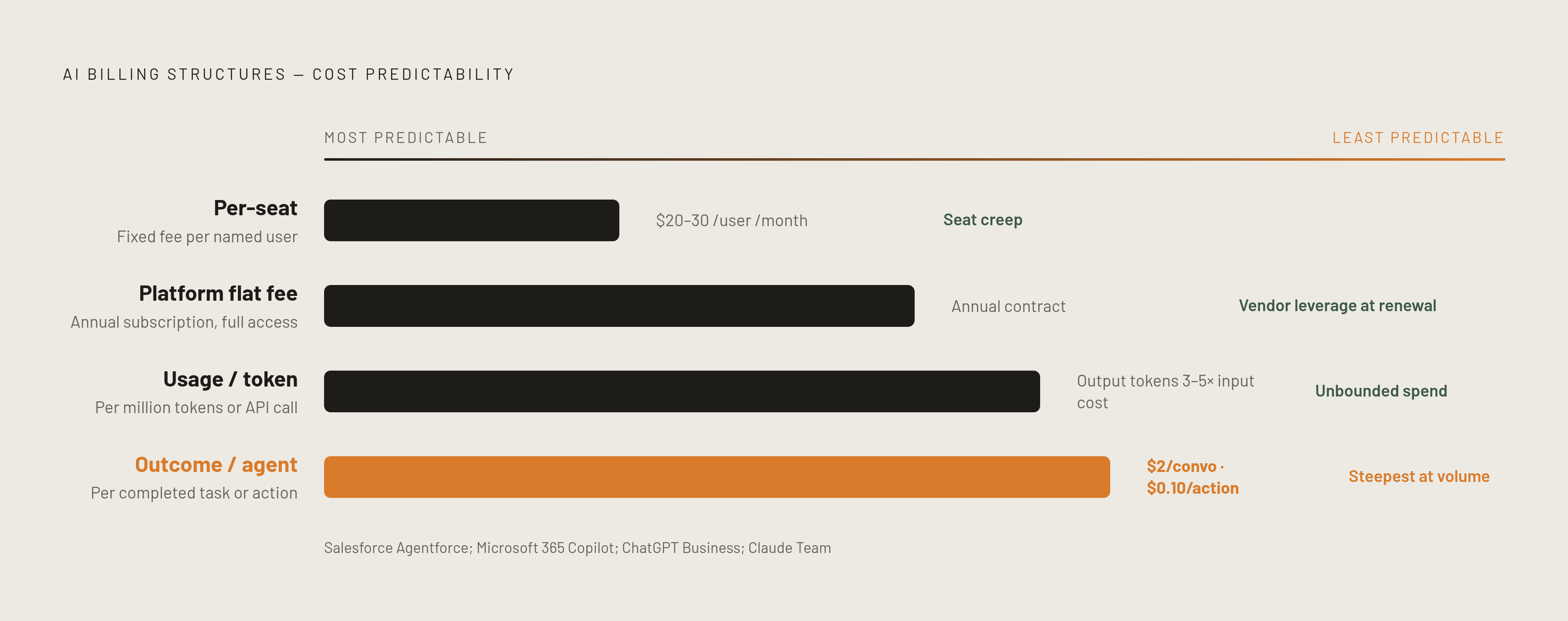
Four billing structures now dominate enterprise AI contracts, and each one puts the cost risk in a different place. The first is per-seat or per-user pricing: a fixed monthly fee for each named user, the same logic traditional SaaS has used for years. As of August 2026, Microsoft 365 Copilot runs $30 per user per month as an annual add-on on a qualifying Microsoft 365 plan; Claude Team runs $20 per seat per month on an annual term; ChatGPT Business runs $20 per user per month annually with a two-seat minimum; Google Gemini comes bundled into Workspace plans at varying tiers, with full access starting at a higher Business Standard tier. Per-seat pricing is simple to forecast and simple to get approved, and that simplicity makes it easy to overbuy: a predictable unit price makes adding seats painless, often faster than actual adoption justifies. It breaks down the moment the work becomes agent-driven rather than user-driven, because you're paying for people logging in while the software does the work on its own.
The second model is usage or token-based pricing, which charges for what gets consumed: tokens processed, API calls made, minutes used. Frontier model APIs from Anthropic, OpenAI, and Google price by the million tokens, with output tokens costing several times more than input tokens. This model has the lowest entry cost and the least predictable bill. Spend rises with activity, rarely comes with a built-in cap, and produces more invoice surprises in high-throughput operational settings than any other structure.
The third model is the platform flat fee or enterprise subscription: you pay an annual charge for access to a platform, common across Source-to-Pay tools and broader enterprise procurement AI. A flat fee buys budget predictability, but it also hands the vendor most of the negotiating leverage at renewal time, since switching platforms mid-contract is expensive and disruptive. The real cost rarely stops at the subscription line. Implementation, ERP integration, and module add-ons stack on top of it, and together they can push year-one cost well past the number quoted at signing.
The fourth model is outcome or agent-action pricing, and it charges per completed task, resolved case, or measurable result. Salesforce Agentforce, for instance, charges $2 per conversation, $500 per 100,000 Flex Credits (roughly $0.10 per agent action), or $2 per resolved case under its pay-per-resolution structure. In theory, this aligns what the vendor earns with what the business actually gets done. In practice, the definition of a "resolved" outcome is a contract term operations teams need to pin down before signing, not after, because cost scales directly with throughput and can produce the steepest bill of any of the four structures once volume climbs. Increasingly, contracts combine these approaches. Salesforce and Zendesk both layer usage fees on top of per-seat contracts, and that hybrid structure, a fixed base plus variable consumption or performance charges, is becoming the default.
What operations teams actually spend at scale and why the headline price is not the real number
The number a procurement team approves and the number an operations team actually pays diverge for predictable reasons, not bad luck. Implementation and integration work, connecting an AI tool to the ERP, the CRM, legacy systems, and the operational data those systems hold, makes up a major share of total cost of ownership, and it doesn't end when the tool goes live. It continues as an ongoing professional services relationship, billed separately from the license itself.
Before any of that integration work pays off, the data feeding the tool has to be usable. Getting operational data clean, consistent, and trustworthy enough for an AI agent to act on reliably consumes the majority of project time on most deployments and represents a disproportionate share of total enterprise AI cost, and all of it gets paid before the tool produces a single usable output. Then there's license creep: per-seat pricing is the easiest model to get approved precisely because it looks predictable, and that same predictability makes it easy to add seats faster than actual adoption justifies. An operations team that sets this year's AI budget by repeating last year's spend is likely to understate the real number substantially if adoption keeps climbing at its current pace.
Layered on top of all this is a transparency problem that works against the buyer by design. Most enterprise AI vendors don't publish prices, and custom, negotiated pricing means the final number an organization pays depends more on its negotiating position than on what the product is actually worth to that business. "Enterprise pricing," in practice, means the vendor charges what the market will bear in that specific negotiation. That isn't a complaint about vendor behavior. Operations and procurement teams need to understand this structural condition and plan around it before they sit down at the negotiating table, because if you walk in without that understanding, you're negotiating blind.
How Each Pricing Model Behaves in Construction, Logistics, and Manufacturing
The same pricing model produces very different cost exposure depending on whether the operational environment is project-based, continuous, or built around physical assets, and asset-heavy industries stress-test every one of the four models differently.
Construction work is project-based, episodic, and constrained by hard deadlines like energization readiness. AI-driven scheduling and procurement tools ingest historical productivity data, resource availability, supply chain signals, and project constraints continuously, and that volume of processing makes token-based billing difficult to predict across the life of a single project. In data center and infrastructure construction specifically, energization readiness depends on real-time tracking of materials and procurement status: without it, a team can't know whether materials will arrive on schedule, whether substitutions will be needed, or how a delay will cascade through the rest of the schedule. The tools that track this run continuously rather than episodically, so usage-based costs are hard to bound in advance. The procurement AI market serving construction includes per-transaction point solutions alongside broader platforms, and a pricing structure that fits one job cleanly may trigger a tier change or a full contract renegotiation the moment it scales across a portfolio of projects. None of this matters, though, until the underlying data is reliable. If cost code accuracy, timecard lag, RFI ownership, submittal dates, and vendor duplication aren't under control, the AI tool produces unreliable output regardless of how it's priced, and the organization ends up paying full price for a tool that delivers little of the benefit it promised.
Logistics runs on volume, continuity, and exceptions, and that combination is where agent-action and outcome-based pricing scales most steeply. A system that autonomously processes disruption signals from weather, port congestion, and carrier delays, rerouting shipments and notifying recipients without a human in the loop, generates billable actions constantly and at scale. If you bill per resolution or per action across a global freight network, cost tracks the volume of exceptions the operation generates, so a period of heavy disruption produces higher operational stress and a higher bill at the same time. Token-based API costs in logistics AI scale with how often data gets ingested and how often the model gets queried, so you need to model your exception rates and query volumes before you commit to a consumption-based contract, not after the first bad month.
Manufacturing carries a different kind of exposure: legacy infrastructure. SCADA systems, older control hardware, and equipment with no REST API all require substantial integration work before an AI agent can act on operational data at all, and that integration cost sits outside the vendor's headline price and has to be budgeted on its own. Predictive maintenance tools that run continuously against sensor feeds, maintenance logs, and utilization data generate ongoing token or API consumption, and the right way to model that cost is per asset per month, against the asset count, not against headcount. That's why asset-based pricing is a particularly good fit for capital-intensive manufacturing operations. The IFS asset-based pricing model, which ties cost to operational assets rather than to the number of people using the system, illustrates the point: asset count reflects operational scope in construction, manufacturing, and logistics more accurately than user count ever could.
The hidden risk in outcome-based pricing: who defines "done" when an agent acts autonomously
Outcome-based pricing moves the definition of value from the buyer to the contract, and once an AI agent is acting autonomously, what counts as a "resolved" outcome becomes a governance question most operations teams haven't actually answered before they sign. When an agent reroutes a shipment, flags a procurement exception, or modifies a schedule on its own, and the vendor bills per action or per resolution, the billing event and the operational consequence of that action are two separate things. The vendor's definition of "resolved" doesn't automatically match what the operations team would consider an acceptable outcome, and that mismatch doesn't resolve itself once the invoice is paid.
Outcome-based pricing can obscure whose definition of resolution actually governs the relationship, and that question carries real consequences in environments where a single agent action cascades downstream: a rerouted shipment, a substituted material, a changed production sequence. The shift from advisory AI, tools that make recommendations a person then approves, to agentic AI, tools that act, changes what the organization is actually exposed to. The risk now lies in what the AI did, and outcome-based billing means the organization pays for actions whose downstream effects may become visible in operations only well after the invoice arrives. Many enterprises are already running more autonomous AI activity than their leadership teams are aware of, and that creates unmanaged risk across operations, compliance, and budget at once, with the pricing model itself partly responsible for hiding the scale of that activity from the people who are supposed to be governing it.
The negotiation consequence is concrete. Before signing an outcome-based or agent-action contract, an operations team needs a contractual definition of what counts as "resolution," a cap or circuit-breaker that limits autonomous actions above a set threshold, and audit rights over what actions the agent took and why. None of those three protections appear in a default vendor contract. They have to be negotiated in.
Auditing Procurement and Operations Data Before Committing to an AI Pricing Model
Before you sign any pricing model, you need to audit what's already happening inside the organization first, because a pricing structure that looks affordable in a pilot breaks predictably once it hits production scale if the underlying data and processes aren't ready for it. That audit starts with data quality: cost codes, timecard accuracy, vendor records, and the other operational data an AI tool will act on need to be clean and consistent before any usage-based or outcome-based bill becomes meaningful, because a tool acting on bad data doesn't just produce bad outputs, it produces billable actions on bad data. It continues with a honest count of how many AI tools are already running inside the business through expense reports rather than formal procurement, since that shadow spend is exactly where visibility disappears first and where the eventual bill arrives with no budget line attached to absorb it. You need to model exception rates and query volumes against the pricing structures on offer, particularly in logistics and manufacturing environments where usage scales with disruption. You need to price out the integration cost separately from the license cost, especially in manufacturing settings running legacy SCADA systems or construction environments juggling point solutions against broader platforms, because that integration line is where year-one budgets most often get blown. It means asking, before any outcome-based contract is signed, who inside the organization currently has authority to define what counts as a "resolved" action, and whether that authority is written into any contract. And it means deciding, in advance, whether asset count, headcount, or action volume is the unit that actually reflects how the business operates, because choosing the wrong unit to budget against guarantees the same invoice shock the next renewal cycle that's already landing on desks today.