Proof of Concept vs. Production Readiness in AI Vendor Claims
Most AI pilots fail because vendors demonstrate models, not the production systems surrounding them.
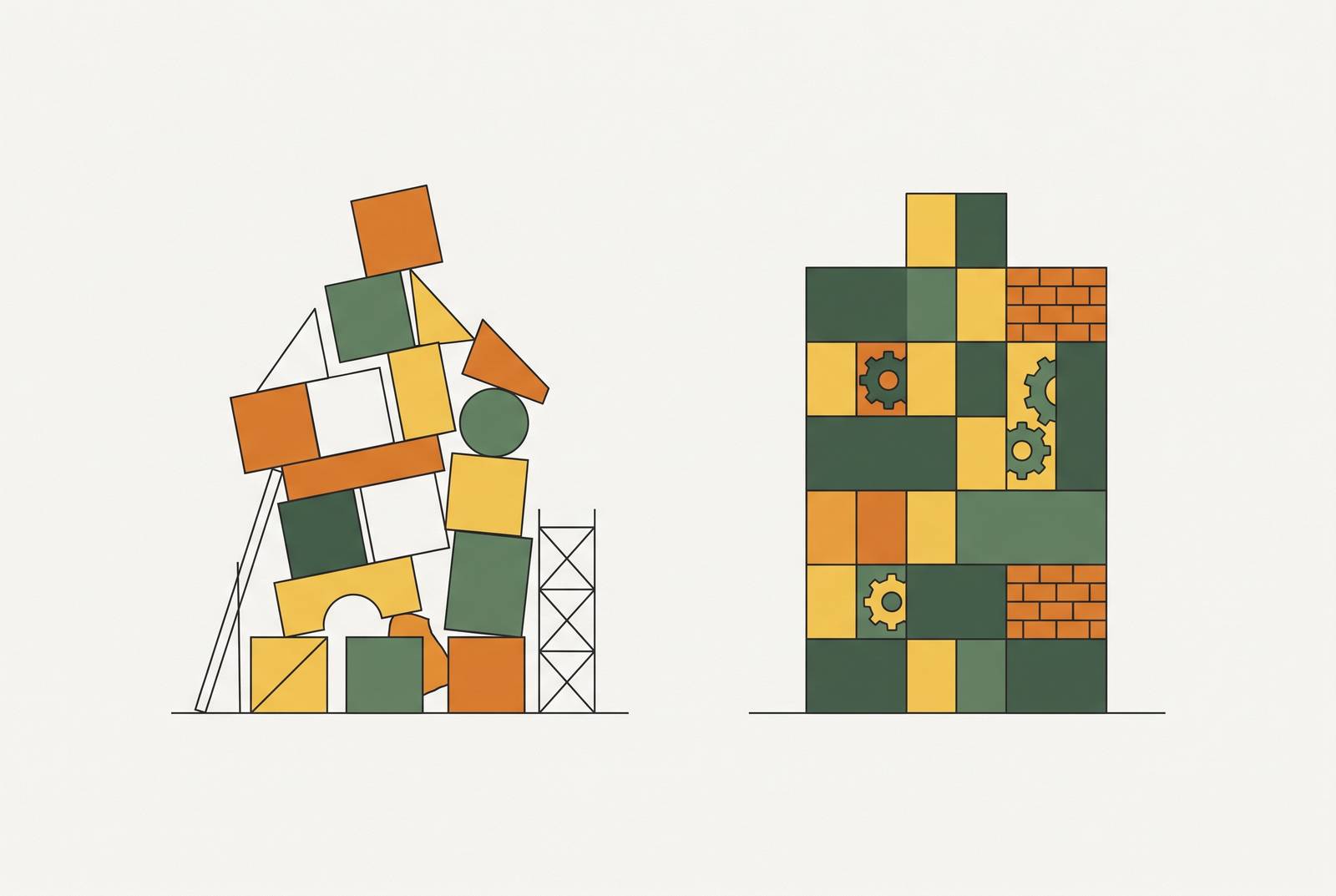
A proof of concept and a production system answer fundamentally different questions, and vendors are only ever asked to answer the first one. That distinction, not any flaw in vendor honesty, is the reason so many AI pilots look brilliant in a conference room and fall apart six months into operation.
Why PoC claims pass pilots and break in production
A proof of concept exists to answer one question, and to answer it fast: can the model produce the right answer? Every choice that goes into building one follows from that single aim. Teams feed it sample data that has been cleaned and curated for the occasion, run it by hand instead of letting it operate continuously, wire it into a demo environment rather than the real stack, and keep one or two people watching every output closely. None of that is dishonest. It is simply the fastest way to answer the question a PoC is built to answer.
Production asks something else. It asks whether the surrounding system can handle the wrong answer safely, at volume, on a Tuesday, when the person who built it is on holiday. It is a different engineering problem, with a different bar for success, and almost none of the work that goes into answering it happens during the PoC phase. Every shortcut that was the right call at prototype stage, the clean sample set, the manual trigger, the one person watching closely, turns into a liability the moment a real business process starts depending on the output. The model barely changes between the demo and the deployed system. What changes is everything built around it.
Exception-blindness is the mechanism that makes vendor claims survive a pilot and then collapse in the field. A PoC gets tested on whatever cases someone could easily assemble, and that process skews hard toward the ordinary ones. Real production traffic does not cooperate that way. It includes the document with two invoices stapled into one PDF, the order that arrives with no reference number, and the record where a field that is always filled turns up empty. These are not edge cases in the statistical sense. In construction, logistics, manufacturing, and retail, they are the ordinary texture of how the business actually runs.
A purchase invoice automation project makes this concrete. A system ran against a full year of real invoices, hit a high rate of straight-through processing, and booked entries correctly against history, yet it still was not in production. Accuracy was never the obstacle. What held it back was the write-back into the financial system, the review step, and the permissions governing who could touch what. This is the pattern underneath most stalled deployments: vendors demonstrate accuracy, and the system wrapped around the model causes production to fail.
Where projects die: the failure rate data
The scale of this gap appears consistently in the data, and the causes named in that data point almost entirely at the ring around the model rather than the model itself, which a demo never tests. Gartner reported that at least half of generative AI projects had been abandoned after proof of concept by the end of 2025, and the reasons it cited, poor data quality, inadequate risk controls, escalating costs, and unclear business value, are all production-layer problems that never surface in a pilot. RAND interviewed sixty-five experienced data scientists and engineers and found that more than eighty percent of AI projects fail, roughly twice the rate of comparable IT projects, with deployment infrastructure treated as an afterthought among the main causes. "Afterthought" names the sequencing failure precisely: teams plan infrastructure after the model works, instead of alongside it.
Data readiness tells the same story from a different angle. Gartner found that nearly two-thirds of organizations either lacked, or weren't sure if they had, the right data management practices for AI, and predicts that through 2026, organizations will abandon a majority of AI projects unsupported by AI-ready data. A PoC can't catch this problem because a PoC runs on data someone has already cleaned up for the occasion. Gartner's forecast for agentic AI adds a forward-looking version of the same issue: a large share of agentic AI projects are expected to be cancelled by the end of 2027, with escalating costs named as the leading cause. Agents that run continuously generate API calls and burn compute tokens around the clock, and that cost is invisible in a demo because a demo doesn't run continuously. It only becomes real once the system is live.
Governance closes the loop on all of this. Deloitte's State of AI in the Enterprise report found that a growing share of organizations already use agentic AI and a large majority expect to within two years, yet only about one in five have a mature governance model in place for those agents. Without governance, a buyer has no mechanism to test a vendor's claims against how the system will actually behave in operation before a contract gets signed. Every cause named across these reports, data quality, risk controls, infrastructure, governance, cost, maps to a layer that sits outside the model, and a demo built to show off the model was never going to test any of it.
The eight things vendors never show in a demo
Turning a PoC into something that survives contact with production doesn't require a better model. It requires building eight operational layers that vendors routinely omit from demos because they are hard to show and easy to defer. Field practice converges on roughly the same list, and each item on it addresses a failure mode a PoC structurally cannot reveal:
- Exception handling: what happens when confidence is low, a required field is missing, or an upstream system is down. In most real business processes, this logic ends up larger than the AI component it surrounds.
- A human review step with a named place and a named person. Someone has to actually see the output, be able to change it, and have that correction captured, because a correction that disappears is training data the system will never get to learn from.
- A test set with an acceptance bar set before anyone measures against it. That's what turns "it seems to work" into a number someone can defend in front of a skeptical auditor.
- Monitoring and alerting that answer the question nobody asks until the system has already failed: how would anyone know if this stopped working? Silent failure is the signature failure mode of AI systems: these systems keep producing confident-looking output even after the real-world data feeding them has shifted underneath.
- Access control and logging: which accounts the system touches, what it's allowed to read and write, and what record exists of what it actually did. Regulatory obligations land here too.
- A defined fallback path for when the system goes down. If nobody has written that path down, the fallback becomes improvisation, and improvisation during a live incident is how records get lost.
- A named owner with real time set aside for the job. Skip this and maintenance quietly becomes whichever developer built the thing's personal problem; that team then can't take on anything new.
- A support arrangement with a known, budgeted cost. Without one, maintenance happens informally for a while, and then it stops happening.
Beyond this list, a broader standard applies: a production-ready deployment draws on seventeen foundational engineering capabilities, including model versioning, automated CI/CD, drift detection, explainability, audit logging, encrypted storage, role-based access control, incident response runbooks, automated rollback, and cost monitoring, and a system with fewer than twelve of those in place isn't ready for production. The exact count matters less than what the list represents: these are disciplines from software and systems engineering, not from AI research, and they are precisely the ground a vendor demo skips over.
There's a single test that cuts through vendor ambiguity faster than any checklist: can the manual process this system is meant to replace actually be switched off? If the old process is still running in parallel with the new one, the organization is paying for both and trusting neither.
The audit trail gap vendors rarely disclose
A vendor's logs record what the model did. They don't record who in the organization initiated the work, how that output flowed into an ERP system or a core banking platform, whether segregation of duties held, whether a local approval happened, or how long the record has to be retained under policy. Regulators and auditors don't hold the model provider accountable for any of that. They hold the deployer accountable for the entire chain, and almost no vendor sales process walks a buyer through what that chain actually requires. The gap stays invisible until an audit forces it into view.
European regulation is where this becomes a concrete, dated-in-money problem. GDPR Article 22 compliance failures surface when regulators audit an automated decision; vendor questionnaires get rejected outright when a system is being sold into a regulated buyer; expensive rework follows when a customer demands an audit trail that was never built. Financial services firms operating under DORA, and critical infrastructure operators under NIS2, cannot run experimental AI systems against operations that matter: production AI in those sectors needs audit trails, explainability, and incident response capability that a PoC was never built to have, and high-risk systems under the EU AI Act require conformity assessments that add months and real cost before deployment.
The procurement gate is where this moves from theoretical to a dealbreaker. A questionnaire from a regulated buyer will ask for ISO 27001 certification, a documented model governance process, and incident response procedures, and a system still at PoC maturity fails that review at the first question. That is the moment a gap that looked academic in a sales meeting becomes the reason a deal doesn't close.
Agents operating with autonomy raise the stakes further. An agent with access to multiple systems and no properly scoped access controls creates a security exposure nobody can detect until after something has already gone wrong, and a demo, by its nature, never runs long enough to reveal that kind of failure.
Construction, logistics, manufacturing, and retail: where the gap breaks
The exception conditions a PoC never tests are predictable and sector-specific, and any operations leader who runs the business in question can name them before a vendor ever opens a laptop.
Construction shows this with particular clarity. AI scheduling tools are being sold into an industry where fewer than a third of major projects finish on time and on budget, and tools built around an AI-first assumption often miss that the real cause of delay lives in procurement, coordination, and commissioning data, not in the schedule itself. One infrastructure contractor's experience shows both what these tools can do well and where the limit sits: the system analyzed historical project data, identified leading indicators of schedule delay, and generated weekly risk reports, and in the first year, projects flagged as high-risk received additional management attention early enough to avoid 68% of the predicted delays. That result came from people acting on signals the AI surfaced, not from the AI acting on its own, a distinction vendors blur constantly in sales conversations. It's also a result built on exactly the conditions a PoC thrives on: clean historical data, well-defined indicators, a human reviewing every flag. Production construction adds dirty procurement data, missing reference numbers, and multi-party coordination gaps. Material delivery timing shows the same gap in miniature: a delivery that arrives too early clogs the site, and one that arrives late stops work, and neither condition is visible in a sample dataset built from historical records that already worked out fine.
Logistics, manufacturing, and retail each produce their own version of the same structural problem, shaped by whatever exceptions are ordinary to that environment rather than rare within it. A logistics operation lives on exceptions like missing manifests and split shipments. A manufacturing line lives on exceptions like sensor drift and partial batch records. None of these are edge cases to the people running those operations. They are Tuesday. A PoC, built on whatever clean sample data was easiest to gather, will never see them, and a vendor demo built on a PoC will never show them either. The work of production readiness is the work of building for exactly these conditions, not around them.
Sources
- From AI Proof of Concept to Production: What changes
- AI Proof of Concept vs Production ML Systems: What European SMBs Need to Know - HST Solutions
- AI Proof of Concept vs Production Deployment: Why 87% of Projects Never Scale - HST Solutions
- From Databricks AI proof of concept to production: Why projects stall and how to scale them