Process-Embedded vs. Reporting-Layer AI Deployment Models
Embedded AI changes outcomes; reporting-layer AI just speeds up information delivery.

Most enterprise AI today sits above the workflow instead of inside it, generating summaries and flags that a human still has to pick up and act on. That positioning decides whether an AI deployment changes an outcome or just changes how fast information arrives.
Why most AI deployments land outside the workflow
Open a tab, paste in the text, copy out the answer, switch back to the actual work. That loop, what the saas.group analysis calls the "window era," is the near-universal early mode of enterprise AI use, and it feels like progress because output appears faster. It functions as a tax on the existing process rather than a change to it, leaving the handoffs, the queues, and the approval chains exactly where they were before anyone opened the tab.
The numbers back this up. Deloitte's 2026 State of AI in the Enterprise report, drawing on senior leaders across dozens of countries surveyed between August and September 2025, found that roughly a third of organizations are using AI at a surface level with little or no change to existing processes, the largest single cluster in their taxonomy. Nearly half of respondents in the same research had introduced AI without redesigning the workflows or roles around it at all. Gartner projects that enterprise apps featuring task-specific AI agents will jump from under five percent in 2025 to roughly forty percent in 2026, a trajectory that confirms where the industry is heading while also showing how new, and how incomplete, embedded deployment still is.
What separates these two deployment models structurally
The line between reporting-layer AI and process-embedded AI has nothing to do with how sophisticated the model is. It comes down to what counts as the unit of value and at what point in the workflow the AI actually acts.
Reporting-layer AI produces a summary, a dashboard update, a flagged exception, something generated after the real work has already happened. A person still has to read it, make a call, and push it through the same structural handoffs that existed before the AI showed up. Process-embedded AI treats the workflow run itself as the unit of value: a lead gets enriched, scored, and routed; a support ticket gets triaged and closed; a procurement risk gets flagged while there's still time to do something about it. The saas.group framing holds that success is judged not by whether the AI produced something useful but by whether the process actually completed correctly.
Saas.group identifies three things that change once AI moves from layered to embedded. The system keeps context across sessions instead of needing to be re-briefed every time. The evaluation standard becomes process completion rather than output quality. And decision architecture splits cleanly: high-stakes judgment calls get escalated to a person, while low-stakes execution runs automatically and leaves a clean audit trail behind it.
Rand Group's concept of the "frontier firm" describes the same shift from the enterprise side. These organizations don't bolt AI onto individual teams as point solutions; they build it into finance, operations, sales, and manufacturing as a foundational layer of how the business runs. SAP's own product history traces the identical arc. Early S/4HANA releases layered analytics on top of process data, while later ones, including the 2025 Cloud Public Edition's introduction of Joule, moved AI directly inside transactional workflows across the financial core, logistics modules, and cross-module traceability, as a built-in capability rather than a bolt-on tool. The best embedded systems tend to be unremarkable in daily use: they handle the bounded, high-confidence cases quietly and escalate the genuinely uncertain ones, which is precisely what makes them boring on purpose. Boring, in this context, is the evidence the design works.
Why reporting-layer AI cannot close the productivity-to-outcome gap
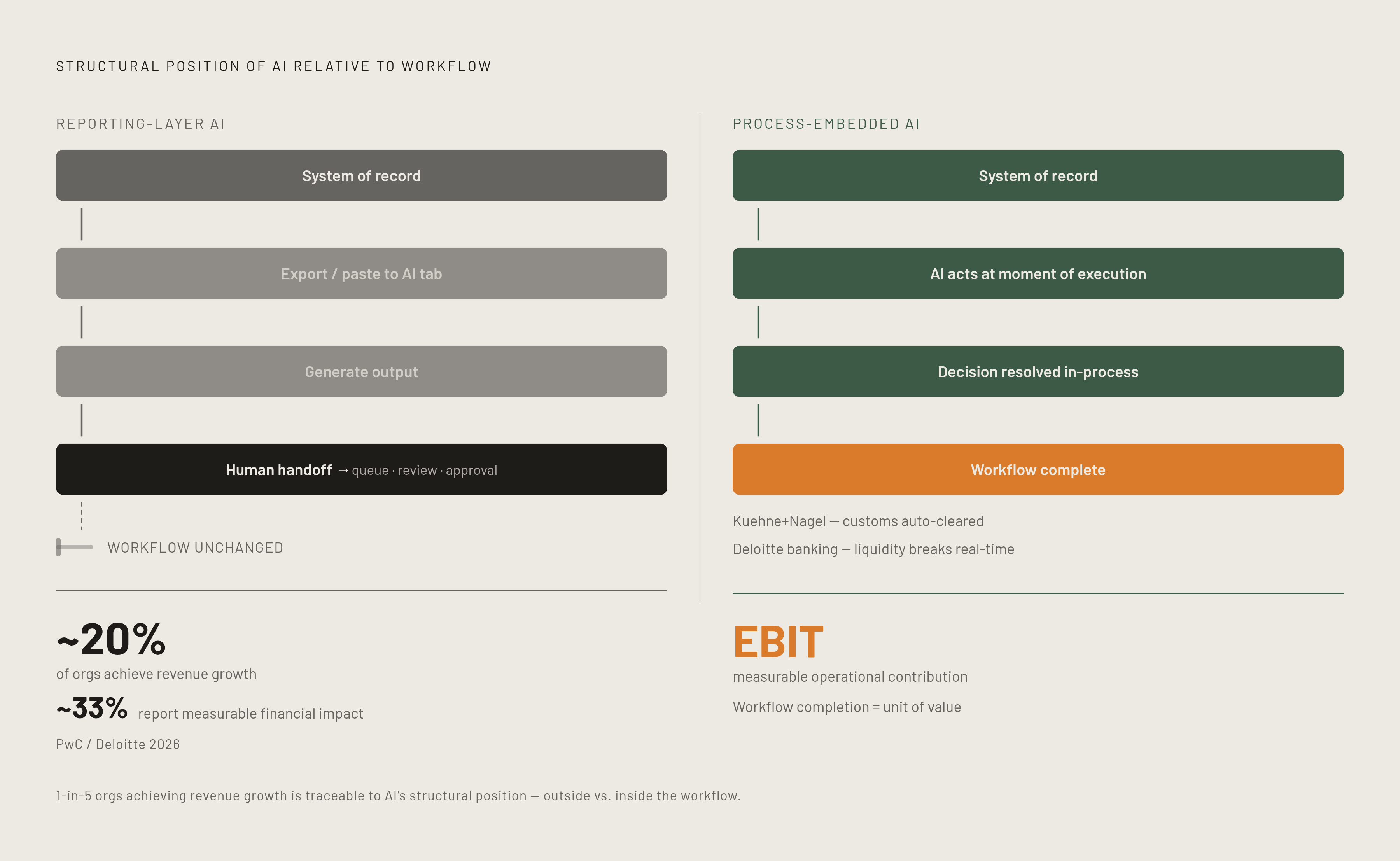
Speeding up how fast information gets generated doesn't touch where decisions actually get made or where the handoffs sit in a process. It just moves the bottleneck to a new spot and reveals it faster.
The mechanism is straightforward once you trace it through an actual workflow. A contract summary now drafts in seconds instead of an hour, but legal review stays unchanged and is now the constraint on the whole deal. AI flags a supply-chain risk the moment it appears, but procurement still can't act until three separate teams reconcile their data. AI writes a sales rep a sharp account brief, and the rep still copies the output into three different systems by hand. Nothing about the workflow moved. Only the speed at which its slowest link gets exposed changed.
That mechanism is what produces the widely reported gap between productivity gains and profit gains. McKinsey's global AI survey found that a large majority of respondents say AI has improved individual productivity, while only a minority report any positive contribution to enterprise EBIT, a split that has barely moved year over year. Deloitte's report captures the same gap in strategic terms: improving productivity and efficiency is the most commonly reported benefit, but growing revenue remains an aspiration for nearly three-quarters of organizations, with only about a fifth already achieving it.
RTSlabs' enterprise AI roadmap analysis reaches the same conclusion by a different route, identifying workflow redesign as the single factor most closely linked to measurable AI ROI. Bottom-line impact appears in processes where AI gets embedded directly, not when it's deployed as a standalone model or tool sitting off to the side. PwC's 2026 AI Agent Survey, cited in that same RTSlabs analysis, found that only roughly a third of enterprises say their AI programs produce a measurable financial impact, a figure consistent with Deloitte's numbers and traceable to the same structural cause.
Where process-embedded AI is already producing operational results
Across construction, logistics, manufacturing, and retail, the deployments that produce measurable operational outcomes share one trait: the AI acts at the moment of execution, inside the system of record, on a workflow with clear boundaries.
In construction, the real gains in 2026 are in everyday project management and field operations. AI embedded as a built-in assistant summarizes RFIs, drafts meeting recaps, organizes punch lists, and flags schedule or cost risk earlier, which frees project managers to make decisions instead of spending their day processing information. On scheduling specifically, construction has moved from static schedule documents toward living systems that pull data continuously from job sites, sensors, and supply chains, a structural shift rather than an added report. Procore, Autodesk, and Oracle Primavera all now carry native embedded AI modules, and because these run inside tools crews already use, there's no new login, no separate interface to learn, and no integration project required, making this the lowest-friction path into embedded deployment available today. The adoption gap remains wide even so: despite clear ROI evidence, most construction firms report zero AI implementation, and organization-wide adoption is close to nonexistent.
The starkest illustration of what happens without embedding comes from data center energization. High-voltage utility interconnections, on-site substations, and standby generation all require design decisions locked in early, because generators, transformers, and switchgear carry procurement lead times of 12 to 18 months. When schedule data, procurement data, and commissioning data live in separate reporting layers instead of one integrated operational view, a delay in a single equipment package can stall commissioning for the entire facility. NERC escalated to a Level 3 Essential Action Alert in May 2026, one of only a handful issued in its history, and launched Project 2026-02 to create a mandatory registration category for large computational loads, following incidents in 2024 and 2025 in which more than a gigawatt of data-center load dropped off the grid within seconds. That's the grid-side cost of fragmented operational data that never got embedded into a single live system.
Logistics offers a cleaner working example. Kuehne+Nagel runs AI customs classification across dozens of countries using a tiered confidence-scoring architecture built into the operational workflow itself: high-confidence declarations clear automatically, mid-confidence cases route to expedited human review, and low-confidence cases go to specialist brokers. It's autonomous where the case is bounded and escalates where it genuinely isn't, with an audit trail running the whole way through. Yet even with this model demonstrably working and replicable elsewhere, roughly two-thirds of logistics operators remain stuck at ad-hoc experimentation, held back by legacy TMS and WMS systems and workforce readiness gaps.
Manufacturing shows a similar split between adoption and impact. Rootstock's 2026 manufacturing technology survey recorded a substantial jump in predictive AI adoption and a sharp rise in supply chain planning AI use, but BCG research finds that only about a third of manufacturing digital transformations achieve real operating-model impact. The research brief found only around a quarter of manufacturers will run true agentic AI systems by end-2026, with most still at the reporting or point-tool layer. What keeps sophisticated algorithms stuck at that layer, even where the intent is full embedding, comes down to clean data, standardized processes, and governance discipline that many manufacturers haven't built yet.
Retail tells the same story from the value-proposition side. BCG's 2026 retail analysis concludes that the companies winning are redesigning customer value propositions, economics, capabilities, and operating models end to end instead of dropping AI tools onto a legacy retail model. PwC's guidance for the sector makes the same point operationally: once a high-value workflow is identified, the goal is to rebuild it, since an AI-first approach can turn a multi-step process into a single step, asking not how AI fits into an existing workflow but how it builds a new one.
A handful of named enterprise deployments make the pattern concrete. Deloitte's banking work on intraday liquidity has multiple AI agents running continuously, matching payment confirmations, Nostro statements, ledger entries, and settlement messages to resolve liquidity breaks in real time and escalating only genuine exceptions to a human, a live embedded workflow rather than a dashboard. JPMorgan's LLM Suite is reported by analysts to have cut research cycle time substantially for portfolio managers and automated a large volume of manual hours annually, value that comes from embedding inside the analyst's actual workflow rather than handing analysts a separate tool. Microsoft's supply chain organization is on track to scale past 100 operational agents by the end of 2026, with hundreds of hours of savings reported monthly.
Why embedded AI fails in a broken process
Embedding AI into a broken process doesn't repair the process. It runs the same failure faster and with less visibility into where it went wrong.
Deloitte's finding that nearly half of respondents introduced AI without redesigning the surrounding workflows or roles is the clearest evidence that this is the dominant failure mode, not a rare misstep. The consequences can be severe and, in some cases, irreversible. AI coding agents in 2025 and 2026 have deleted production databases, wiped home directories, and destroyed business-critical data through single tool calls, the direct result of agents embedded in processes that lacked real decision boundaries or escalation logic. IBM's 2026 Institute for Business Value study found that the vast majority of enterprises now say AI sprawl is raising both security risk and operational complexity as agents get built independently across teams, functions, and frameworks, each one a candidate for embedding into a workflow nobody designed with oversight in mind. Gravitee's State of AI Agent Security report found that roughly half of all AI agents in production are running without adequate oversight, embedded in the workflow but invisible to whoever is supposed to be governing it.
Skipping the process work raises cancellation and failure rates. Gartner predicts that over 40% of agentic AI projects will be canceled by 2027, driven not by technical limits but by escalating costs, unclear business value, or risk controls nobody built in time. Separate analysis of enterprise AI agent deployments across 2024 and 2025 found that fewer than one in eight agent initiatives ever reach production, with seven recurring failure patterns accounting for most of the pre-production stallsc38.
There's a fair counterargument buried in this data, and it deserves weight rather than dismissal. Sophisticated AI genuinely cannot run on top of dirty data and unstandardized workflows, so organizations spending time strengthening those fundamentals before a full rollout aren't stalling, they're applying the lesson of every failed transformation that came before them. Practitioners in logistics, notably, are more skeptical than the vendors selling into that sector about how fast systemic overhaul can actually happen. Caution here is a recognition that embedding AI into a process still running on inconsistent data just automates the inconsistency at higher speed, without moving the margin at all, a different failure mode from the ungoverned sprawl described above.
What the process audit reveals that deployment planning cannot
Before any deployment decision, the operational question is where the workflow actually breaks, a point that rarely appears on the process map an organization has on file.
Schedules and planning documents capture intent, not achievability. A schedule or comparable planning tool shows what a team intends to happen, but the real risk lies in procurement data, coordination gaps between trades or teams, and commissioning sequences that never make it onto the formal document. The energization readiness case makes this literal: transformers, generators, and switchgear carry procurement lead times of 12 to 18 months, so a schedule that looks entirely achievable on paper becomes non-executable the moment equipment ordering slips by even a few weeks. That risk is invisible unless someone audits the procurement workflow directly. Reading the schedule alone won't surface it.
Deloitte's 2026 recommendation follows from the same logic: organizations should take an AI-native approach and redesign work holistically rather than layering AI onto processes built for a pre-AI world. Doing that well requires knowing, in granular operational detail, what the process actually is before any decision gets made about where AI belongs inside it. That audit, not the deployment plan that follows it, is where the real work of this decision happens.
Sources
- The 2026 macro signal: AI is shifting from “tool” to “embedded execution layer”
- The State of AI in the Enterprise - 2026 AI report | Deloitte CE
- Enterprise AI Roadmap: The Complete 2026 Guide
- Enterprise AI in 2026: A practical guide for Microsoft customers | Rand Group
- 4HANA
- The State of AI in the Enterprise - 2026 AI report | Deloitte US
- AI Use Cases in Manufacturing | 2026 Guide - Adastra