Predictive Maintenance Platforms for Heavy Industrial Equipment
Most predictive maintenance systems fail at execution, not accuracy.
A maintenance manager gets an alert flagging a bearing on a haul truck as degrading. The model is right. Three weeks later, the truck goes down anyway, because the alert sat in an inbox, no work order got cut, and no technician was ever assigned to look at it. The dominant failure mode in predictive maintenance is not a bad model; it is the distance between a correct alert and a completed repair.
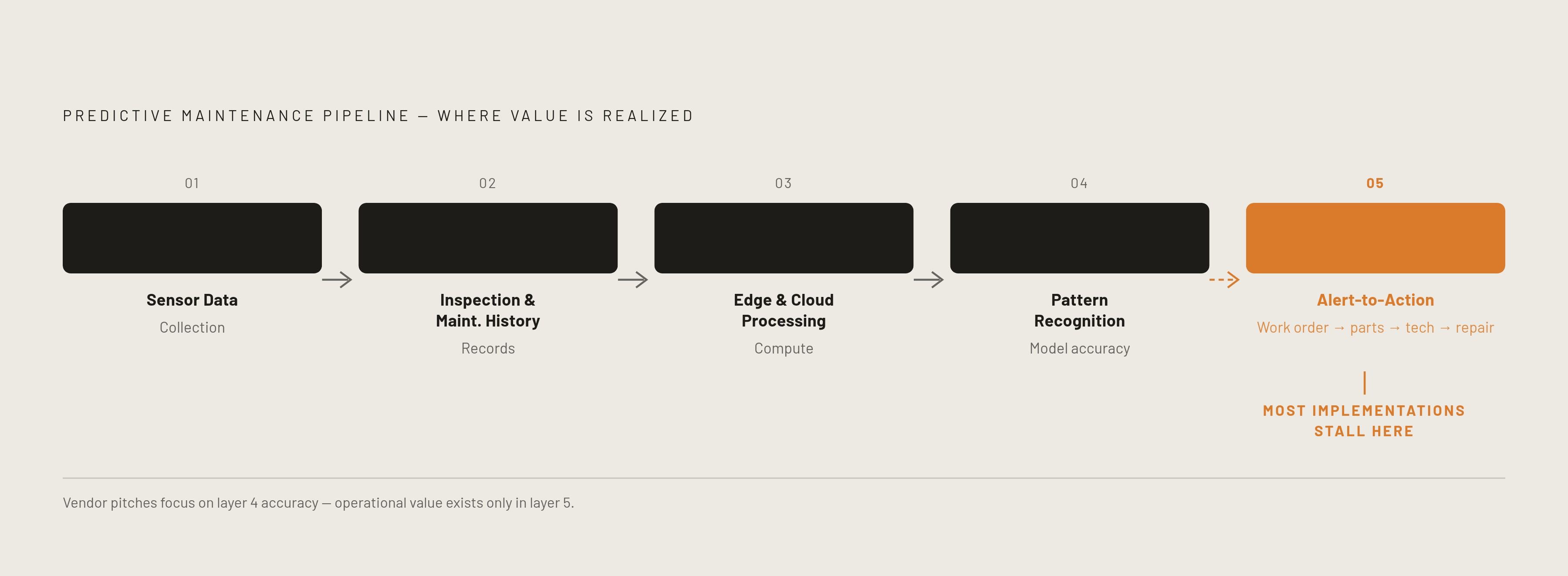
That distance is the subject of this piece. Vendors compete on accuracy scores because accuracy is easy to market and easy to benchmark. But accuracy answers the wrong question for an operations leader deciding what to buy. The pipeline from sensor to intervention runs through five steps, data collection, pattern recognition, alert generation, work order creation, and scheduled repair, and the value of the entire chain only gets realized at the last one. A system that stops at alert generation has done analytical work without doing any operational work. One practitioner framing captures this bluntly: a predictive maintenance system that generates alerts nobody reads is an expensive dashboard.
Instead of asking how accurate a vendor's model is, the sharper question is what happens automatically after the alert fires, and whether a human has to manually intervene to make anything happen at all. Heavy equipment operations feel this gap acutely: the average fleet loses roughly one in seven annual operating hours to unplanned breakdowns, failures that predictive alerts, converted reliably into scheduled action, would largely prevent. The rest of this piece works through what "converting reliably" actually requires, architecturally and operationally, and which platforms are built to do it.
The Sensor-to-Work-Order Pipeline in Heavy Industrial Equipment
Predictive maintenance for heavy equipment runs through five layers, and each one introduces its own failure point that no amount of downstream AI sophistication can fix.
Layer one is sensor data collection. Vibration sensors are the most widely deployed sensor type in the field, joined by temperature probes, pressure sensors, acoustic monitors, oil analysis, and power consumption monitoring. MEMS sensors are now available at accessible per-unit costs, and OEM telematics, Cat Product Link, Komatsu KOMTRAX, Volvo CareTrack, already broadcast hundreds of CAN bus data points from post-2015 equipment. A lot of the raw material for prediction is already flowing off machines that operations teams already own.
Layer two is inspection and maintenance history, but most implementations quietly skip it. AI models need structured, machine-specific history: inspection records, work orders, parts replacement logs, fluid analysis trends over time. Without that baseline, a model has nothing to compare a live reading against, so a genuinely anomalous vibration signature and normal operating noise look identical to an algorithm with no history to reference.
Layer three is edge and cloud processing. Edge devices handle anomaly detection in sub-second windows, while cloud platforms aggregate data across the whole fleet for trend analysis. Many practitioners assume predictive AI requires modern equipment, but it doesn't. Platforms like Litmus connect to legacy machinery and convert analog or serial protocols into a standard, normalized format, addressing the problem that a current AI model cannot run on data trapped inside a 1980s PLC. Old equipment isn't excluded from this shift; it just needs a translation layer first.
Layer five is alert-to-action, where the alert fires, a work order is created, parts are reserved, a technician is assigned, and repair is scheduled during a planned window, and vendor pitches built around model accuracy give this layer the least attention.
Where the Pipeline Breaks: Bad Data, Skills Gaps, and Last-Mile Execution
Before evaluating any vendor, an operation needs an honest accounting of its own readiness, since most predictive maintenance implementations fail for reasons unrelated to the AI's accuracy.
Start with the data. Fleets running on paper checklists or generic digital forms have no structured, machine-specific history to feed an algorithm, and without years of that history, there's no baseline to compare against, full stop. This is a data foundation problem, not a software problem, and no vendor's model can compensate for it after the fact.
Then there's the execution gap, and it's worth describing exactly, because it isn't hypothetical. The AI generates an alert, the alert lands in an email inbox, nobody creates a work order from it, and the failure occurs anyway. That sequence describes the default state of any organization that deploys an alerting platform without wiring it into CMMS workflow. The alert was correct. The bearing failed anyway. Nothing in the technology stack forced a human to act on it.
Workforce readiness compounds the problem. Only a minority of technicians consider themselves well-prepared to work with predictive technologies, and a significant share of companies outsource maintenance work specifically because they lack the internal skills to run it themselves. The workforce is aging on top of that: a large majority of maintenance professionals are over 50, and Deloitte and the Manufacturing Institute project millions of manufacturing jobs will remain unfilled by 2033, so the skills gap widens rather than narrows over time.
Field-level adoption data confirms the pattern rather than contradicting it. McKinsey's 2025 State of AI research found that most organizations use AI in at least one business function, but only a small fraction have scaled it fully across the enterprise. That gap between piloting and operating is where competitive advantage sits in the current market, because most competitors are stuck somewhere in the middle. The OxMaint 2025 Global Industry Report names three specific adoption barriers: budget, because ROI is hard to justify up front; skills, meaning workforce readiness; and cybersecurity, because connecting operational technology to IT networks introduces exposure that plenty of operations aren't prepared to manage.
Gartner has flagged a related structural risk for the current wave of agentic systems: more than four in ten agentic AI projects could be abandoned by 2027 due to complexity and cost. Industrial environments demand accuracy standards north of 99.5 percent with essentially zero margin for error, and platforms that meet that bar, paired with clean data requirements and skilled implementation partners, will survive the shakeout. Anything sold as plug-and-play, without accounting for the data and skills gaps above, likely won't.
The architectural divide that determines which platforms close the loop
None of the failure modes above are model problems. They're architecture problems, and architecture is the one variable a buyer can actually evaluate before signing a contract. The most consequential difference between predictive maintenance platforms isn't model quality; it's whether the platform converts a prediction into a tracked, completed work order without a human manually bridging the gap.
Two architectures dominate the market. Pure-play AI analytics platforms detect and diagnose degradation with real precision, and they output alerts, dashboards, or diagnostic reports, but they require a separate CMMS to turn any of that into a tracked maintenance action. CMMS-native AI platforms keep anomaly detection and work order generation inside one system, so a confirmed prediction automatically creates a work order, attaches asset history and recommended parts, assigns a technician, and documents the intervention in the asset record.
This explains a complaint heard constantly from practitioners: the signal from pure-play platforms is excellent, but the system depends on a person to manually cross the bridge from "alert received" to "work order opened," and that bridge is exactly where most implementations stall.
Agentic AI is narrowing that gap faster than most buyers realize. A fully closed loop, defect detected, work order created, parts reserved, technician assigned, repair scheduled, with zero manual data entry anywhere in the sequence, is now technically achievable. Plex by Rockwell Automation is a working example: its AI agents read live manufacturing context like OEE, surface issues as they emerge, and generate reports and dashboards from natural language queries rather than manual dashboard configuration.
A layer most buyers never see sits underneath either architecture: data infrastructure. Platforms like Cirrus Link's MQTT/Sparkplug, Cumulocity's medallion architecture, and HighByte's data contextualization aren't predictive maintenance platforms in themselves, but they're prerequisites for either architecture to work at scale, because without them, AI models are fed inconsistent, uncontextualized data, the "data swamp" problem that undermines everything built on top of it. The evaluation question for any platform, then, is simple to state and hard for vendors to dodge: does it close the loop inside one system, or does it hand off to another system, or a person, to finish the job?
Ten platforms evaluated on whether prediction converts into action
The following platforms are evaluated on AI prediction capability, CMMS work order integration depth, sensor compatibility, deployment speed, pricing, and documented field results, ranked by OxMaint's independent operational assessment through Q1 2026 and IIoT World Days 2025 panel discussions.
OxMaint ranks first in OxMaint's own 2026 assessment for CMMS-native AI predictive maintenance, combining AI prediction and full CMMS capability at entry-level pricing. Anomaly detection converts sensor data straight into assigned, tracked work orders without a manual handoff, IoT integration runs through REST API and OPC-UA, and the platform supports low-cost industrial sensors. A free tier is available, AI is included at every paid tier starting at $8 per user per month, deployment is self-serve and takes days rather than weeks, instrumented assets reach time to first predictions, and there is no implementation fee. It fits teams that need predictions to become maintenance actions automatically, not teams looking for another dashboard.
Augury is a pure-play AI platform built around proprietary sensors and models trained on millions of machine hours, and its vibration analytics for rotating equipment, motors, pumps, fans, compressors, are as good as anything in the category. Predictions don't auto-generate tracked maintenance actions, though; a separate CMMS is required to close the loop, and enterprise pricing puts it out of reach for smaller operations. It suits large operations that already run CMMS infrastructure and want the best rotating-equipment diagnostics available.
Samsara brings a strong fleet and industrial IoT platform with AI-powered condition monitoring and a solid sensor hardware ecosystem. It's dashboard-focused, so work order generation depends on separate CMMS integration, and per-device pricing scales up quickly across large deployments. It fits fleet operations already inside the Samsara ecosystem.
IBM Maximo (MAS) is the established enterprise EAM platform, with watsonx and Maximo Monitor layering in AI and digital twin capability on top of deep CMMS integration. Implementation cost and multi-year rollout timelines confine it to the largest operations, and it requires full-time administrative staff to run, which rules it out for anything below a substantial technician headcount.
Fiix AI, from Rockwell, pairs developing AI capabilities with FactoryTalk Optix integration built for Rockwell-heavy plants. AI features concentrate in the higher pricing tiers, though the underlying platform has strong industrial PM scheduling and compliance tooling. It's best suited to plants that already run deep Rockwell PLC and condition monitoring infrastructure.
Samotics takes a different technical approach entirely: electrical signature analysis (ESA) monitors motors without physical contact, reading degradation through electrical current patterns rather than vibration. No vibration sensors are needed for motor-driven equipment, but there's no native CMMS, so work order management requires separate integration, and pricing runs per motor at enterprise scale. It's a strong fit for motor-heavy industrial environments specifically.
Uptake focuses on industrial AI analytics for heavy industrial and energy assets, with particular strength in mining, energy, and transportation. CMMS integration is limited; it functions primarily as an analytics overlay sitting on top of whatever CMMS an operation already runs, at enterprise pricing. It suits large-scale energy and mining operations with existing CMMS infrastructure already in place.
UpKeep's Nova AI layers AI capability onto UpKeep's established CMMS platform, available starting at the Essential tier. The AI features work, but they're still developing, deeper predictive analytics require higher tiers, and sensor integration runs through the UpKeep Edge hardware add-on, billed as a separate subscription. It fits existing UpKeep users who want to add AI incrementally rather than switch platforms.
KCF Technologies, founded by Penn State researchers in 2000, runs the SMARTdiagnostics platform, made up of cloud software, the SMARTsensing hardware suite, and a SENTRYservices team of certified vibration analysts. SMARTdiagnostics bundles a Workbench analysis tool, a Desk issue management system, and DeskAI for AI-based fault detection. The SD Connect mobile app, released for Apple and Android in 2023, gained a built-in motion amplification camera starting in 2026. IoT HUB, introduced in 2021, supports wired sensors in high-temperature or shielded environments and integrates third-party, legacy, and OEM sensor types, and Piezo Sensing, introduced in 2024, catches early-stage bearing faults before they escalate. SENTRYsolutions analysts hold Mobius Certified CAT II and III vibration certification, and the platform is a strong fit for rotating industrial equipment across manufacturing and heavy industry.
Arch Systems, highlighted at IIoT World Days 2025, specializes in extracting value from existing machine data in electronics and discrete manufacturing, using generative AI for root cause analysis on downtime and quality issues. It can pull data from older machines without replacing them. CEO Andrew Scheuermann cited OEE increases of 60 to 80 percent at manufacturers that replaced physical inspection stops with AI-driven quality validation. The platform functions less like a dashboard and more like a digital expert looking over an engineer's shoulder, running cross-factory analysis that human teams rarely have time for.
Infinite Uptime, also highlighted at IIoT World Days 2025, positions itself as reliability as a service, with prescriptive AI that specifies what to fix and when, instead of just flagging that a fault is developing. It combines physics-based models with machine learning, and outcome-based OPEX pricing lowers the upfront risk of adoption. Co-CEO Karthikeyan Natarajan cited a 96 percent customer acknowledgment rate and improvements in mean time between failures of up to 75 percent. The platform also targets a specific workforce problem: as senior technicians retire, it digitizes their experiential knowledge into prescriptive alerts, addressing the tribal knowledge drain directly.
What documented deployments show about where value is captured
Field data lines up with the architectural argument: the deeper the loop closes, the larger the gains. Platforms that stop at alerting produce the smallest returns of the group.
Unilever's Indaiatuba plant in Brazil deployed AI maintenance across a large network of IoT sensors and recovered its investment in under seven months, alongside substantial annual savings and a large reduction in maintenance costs. Those numbers weren't produced by detection alone; they required full integration between detection and maintenance action, where every degrading asset the sensors caught actually turned into a scheduled repair rather than a logged alert.
A construction fleet that implemented AI predictive maintenance in the first quarter of 2025 saw hydraulic failures drop by nearly three quarters within six months, extended equipment life, and a substantially reduced annual maintenance budget. The savings paid for the system multiple times over in year one alone.
An automotive manufacturer running a stamping press avoided a catastrophic failure and a full rebuild, a single averted incident that represented a large prevented cost on its own. The value only materialized because the alert converted into a scheduled intervention before the press actually failed, which is the entire argument of this piece condensed into one plant floor decision. The prediction was correct. The work order got cut. The technician showed up. That's the loop, closed.