Energization Readiness Tracking Tools for Large Construction Projects
Delays hide in gaps between parties until energization dates slip beyond recovery.
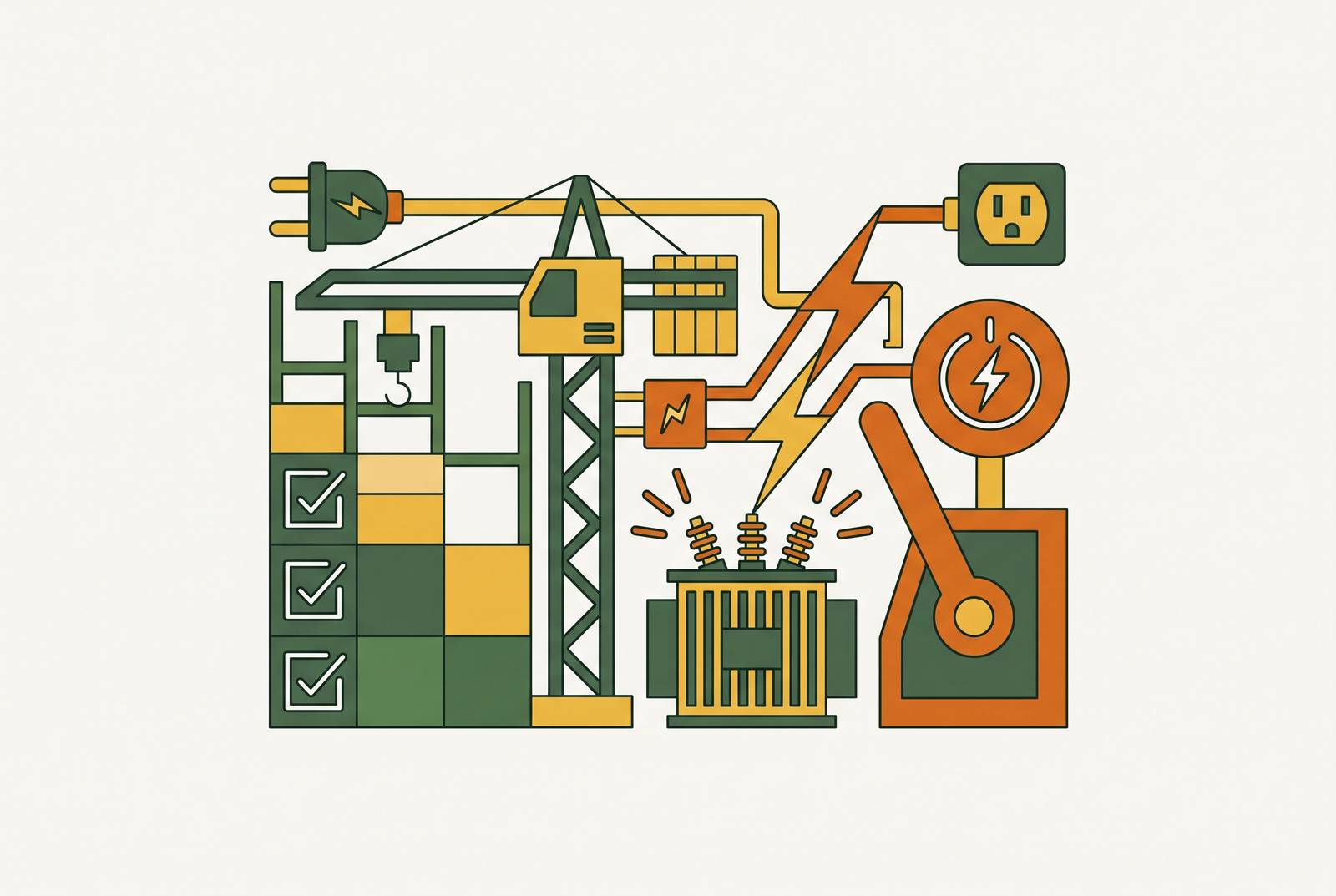
Energization readiness tracking fails on large construction projects not because teams lack software, but because the tools they already run track task completion, and not gate readiness. The deeper failure is structural: no single party, utility, customer, or contractor, ever holds the full picture, which is what keeps delays invisible until the schedule has no room left to absorb them.
Why energization readiness differs from general construction progress tracking
Energization readiness means confirming that a facility can safely and legally take live power: the switchgear is tested, the utility has signed off, the customer's internal systems are staffed and ready, and every regulatory box sits checked at the same moment. That last clause is what sets it apart from almost every other milestone on a construction schedule. Most milestones belong to one team and move at that team's pace. Energization belongs to no one team, because it requires a utility, a customer, and often a handful of third-party contractors to finish separate, parallel streams of work and land on the same date, in the same condition, at the same time.
That convergence requirement is what makes energization a structurally different kind of tracking problem than drywall completion or MEP rough-in. A general contractor can look at a percentage-complete report and know roughly where a task stands, because one team owns the task from start to finish. Energization has no such owner. The utility controls transformer delivery and interconnection approval. The customer controls internal commissioning and staffing. Third parties control permitting, inspections, and in some cases the HV cable pull itself. Each of these parties can be fully on schedule within its own silo and the overall energization date can still slip, because the convergence point, not any single task, is where the real risk lives.
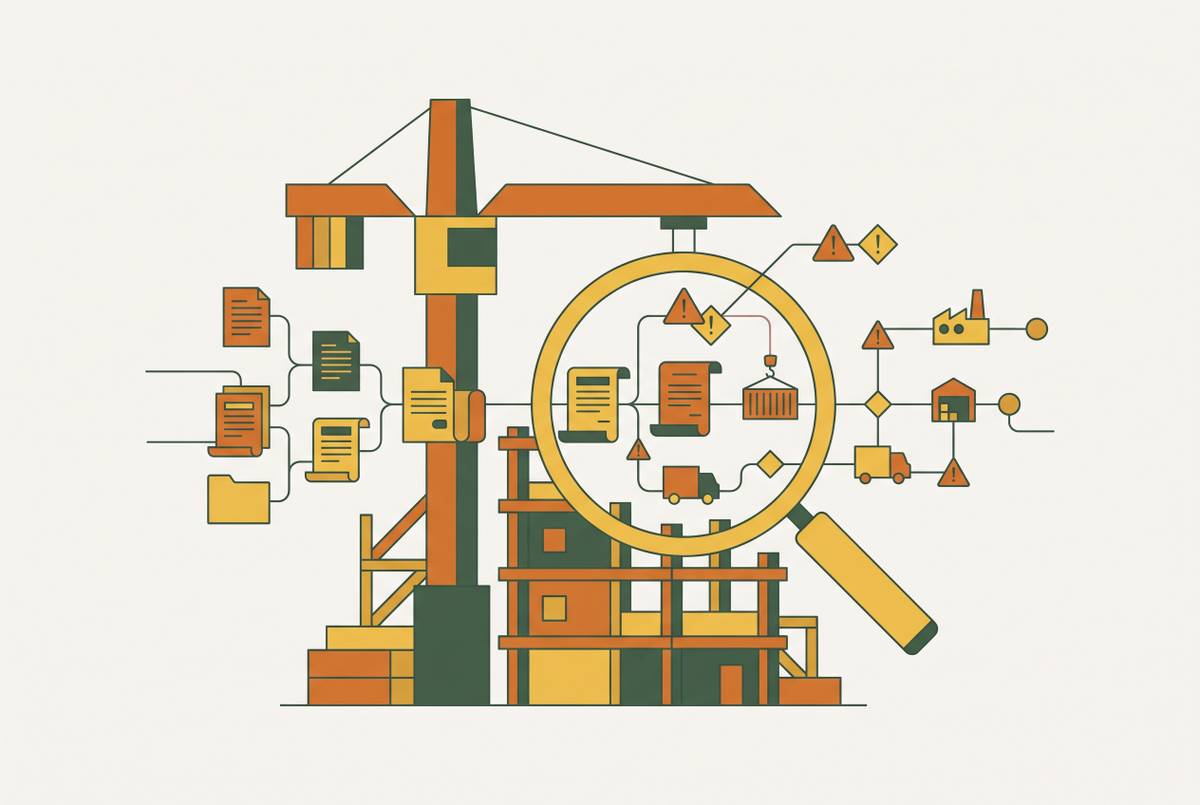
Treating energization as "just another late-stage task" on a master schedule means that gaps between these parallel streams go unnoticed until the streams are supposed to meet and don't. By the time a scheduler sees daylight between what the utility expects and what the customer has delivered, the recovery window has often already closed. The commissioning-to-energization period is where declared schedule status and what a commissioning record can actually prove start to pull apart. A task can say "complete" on a master schedule while the actual physical and documentary proof needed to energize the building doesn't yet exist.
The multi-party attribution problem that makes delays invisible until unrecoverable
The dysfunction at the center of energization delay isn't a lack of effort from any one party. Utilities, customers, and third parties each track their own piece of the project, and time gets lost in the space between those pieces, where it lands on no one's dashboard. No one is lying about their status. Each party is reporting accurately on what it can see, and what it can see stops at its own boundary.
The California Public Utilities Commission's energization timelines workshop, held June 30, 2025, put hard numbers to this problem for the first time in a public setting. One large utility told the workshop it was reporting on roughly 60% of the data the Commission actually needed, and critically, that utility was not tracking customer-caused delay separately from its own utility-caused delay. That single gap means SCE had no structural way to show a regulator, or itself, how much of an energization delay belonged to the customer and how much belonged to the utility. Another large utility was further along on pure data capture, with 83 of its 96 reportable fields populated and a stated commitment to reach all 96, but it faced the same underlying question the first utility did: neither could yet draw a clean line between where its own responsibility ended and where the customer's began.
That line matters because it's the exact boundary where disputes form. When a project slips and nobody can say with precision whose delay caused it, the parties default to disagreement, and the disagreement plays out during the energization handover itself, the single window where speed matters most and slack exists least. When tracking systems are built around one big energization milestone instead of a sequence of smaller, separately owned gates, they catch this kind of dispute only after it has already surfaced as a missed date. SCE's own response to the problem shows how long it takes to close an attribution gap even with regulatory pressure driving the work. SCE launched the Building, Renovation, and Project Planning Portal in July 2025 specifically to raise data accuracy and tracking capability, and the portal's own process improvement initiative, meant to finally define where IOU responsibility stops and customer responsibility starts, isn't targeted for completion until the third quarter of 2026. A full year passes between standing up the portal and actually defining the boundary the portal was supposed to track. Attribution isn't a feature you bolt onto a system; it's a definition that has to exist before the system can report on it honestly.
Why task-completion tracking catches energization problems too late
Standard progress tracking, built around percentage-complete reporting against a CPM schedule, measures activity, not readiness. A task can be nearly complete and still be the single item blocking energization, if the small remaining portion happens to be the gate-critical handover step, such as final utility sign-off or a timestamped commissioning proof. Percentage-complete tells a scheduler how much work is left in hours or dollars. It tells them nothing about whether the work that's left is the work that actually gates the next party's ability to move.
Gate-readiness tracking assigns one owner, one date, and one piece of proof to each handover. That structure catches a broken dependency weeks before a percentage-complete report would, because it flags the moment a gate's proof doesn't exist yet, rather than waiting for an aggregate completion number to stall. The commissioning-to-energization window is where this difference costs the most, because it's exactly where multi-party handoffs pile up, where as-built field conditions start to diverge from the BIM model the schedule was built on, and where equipment gaps that got quietly tolerated in earlier phases turn into hard stops.
Long-lead electrical equipment, transformers, switchgear, HV cable, sits at the center of this. These items run on procurement timelines that have little to do with construction progress on site, and utilities have started placing bulk orders well in advance precisely because a transformer delivery gap can gate an entire energization date no matter how far along the rest of the project is. A percentage-complete schedule has no native way to flag that kind of risk, because the transformer order sits outside the construction activities the schedule tracks. If a tool syncs schedule data, through one scheduling platform or another, with commissioning activity and equipment procurement status, it can surface a transformer delay as a live risk weeks before it becomes a critical-path event. A tool that only reports task percentage has no way to see it coming.
What purpose-built operational readiness platforms track differently
A newer category of software built specifically for commissioning and operational readiness tracks buildings at the level of individual systems and assets, rather than rolling everything up into an activity percentage. That granularity is what lets these tools work as gate-management systems, not general progress dashboards.
Facility Grid's Operational Readiness Platform, expanded in January 2025, gives a concrete picture of what this looks like. Its Timeline Monitor and Schedule Sync feature tracks critical tasks and flags potential delays while syncing Oracle P6 and Microsoft Project schedules directly with Facility Grid's own QC and commissioning activities, closing the gap between what the master schedule says should be happening and what commissioning records can actually prove. Its Accelerated Turnover Package pulls together the documentation, photos, and warranty records tied to a building system or piece of equipment into one package, giving the owner a complete handover already in place. A Comprehensive Audit Trail keeps a timestamped digital record of every sign-off, which removes the documentation risk that comes from relying on someone's memory of a verbal approval and gives every party a clear, shared record of who signed what and when. Asset Closeout Signoff runs a formal final review on one or more pieces of equipment, notifying everyone who needs to weigh in and producing a full report, covering data, parameters, document status, and readiness records, ready for electronic sign-off. A Procore integration lets teams see equipment status, QA, QC, and commissioning activity without leaving the Procore environment they already work in day to day.
On the utility side, builder service portals that let customers upload documents, check project status, and message utility teams directly reduce the back-and-forth that creates attribution gaps, and assigning a dedicated project manager at the start of a project gives the customer-utility relationship one accountable point of contact. You confirm readiness through a completed sign-off chain and a full document record, not by guessing from how far along a task bar looks on a schedule chart.
Where purpose-built tools break down
A purpose-built readiness platform running on top of a fragmented, manually-updated, multi-party process will reproduce the same blind spots it was built to fix, because the platform can only report what the process actually feeds it. Good software can't manufacture clarity if a workflow was never designed to produce it.
SCE's own experience makes the point. The attribution gap between SCE and its customers was never just a data-capture limitation at the tool level. SCE's process improvement initiative to finally define IOU and customer start and stop points isn't due until the third quarter of 2026, roughly a year after the BRPPP portal itself went live in July 2025. The portal came first; the process definition it depends on came after, and had to be rebuilt almost from scratch before the portal could report anything reliably. That sequencing problem occurs across enterprise technology deployments generally: a tool goes live before anyone has defined the process it's meant to track, the tool then produces incomplete or inconsistent data, stakeholders stop trusting what it shows them, and everyone quietly falls back on the manual workarounds, emails, phone calls, spreadsheets, that recreate the exact fragmentation the tool was bought to eliminate.
You need a specific process structure in place for energization readiness before any tracking tool, however well built, can run on reliable inputs. Every gate in the sequence needs a single named person as its owner, not a team and not a stakeholder group, because shared ownership is functionally no ownership when a deadline slips. Every gate needs one piece of proof that a system can read and timestamp automatically, rather than a verbal confirmation in a meeting or a note typed into a spreadsheet cell. The dependency chain between utility-controlled work, customer-controlled work, and third-party work needs to be mapped out explicitly, because a P6 schedule will never infer that chain on its own. Long-lead equipment status for transformers, switchgear, and HV cable needs to sit on the same tracking surface as commissioning activity, and its procurement milestones need to be treated as gates, not background noise. Utilities that have actually sped up their energization timelines report that the changes that moved the needle were process changes first: setting service level agreements with defined minimum and maximum response times, assigning a dedicated project manager from day one, and building internal dashboards for visibility. The digital tools came in afterward to reinforce decisions the process had already settled, not the other way around.
How AI agents change what construction can track
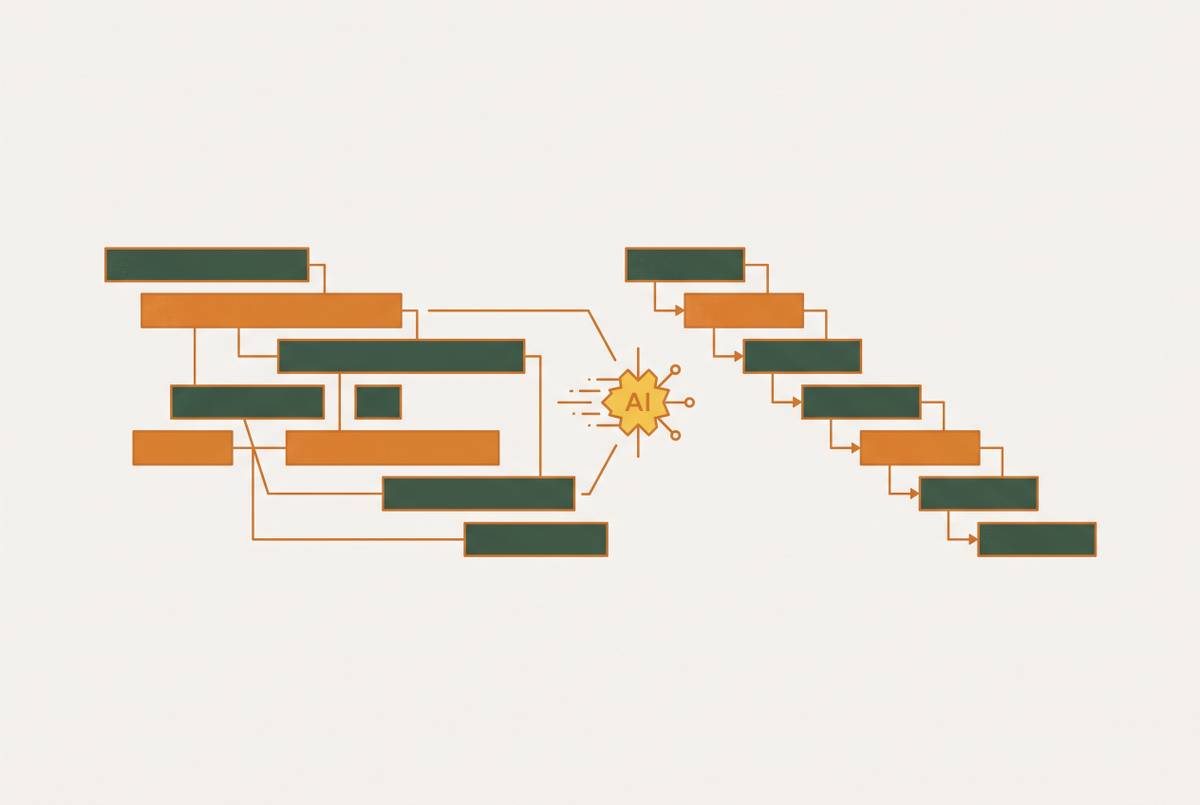
AI-native tracking ties field evidence to the project schedule in close to real time, so it expands what you can actually observe during the energization window, and that lets you run scenario analysis on emerging delays and understand their downstream impact before they turn into critical-path events. That's a genuine expansion of capability, not a marketing claim. It closes gaps that sat outside the reach of the tools described above.
Three specific gaps stand out. Field-to-schedule linkage lets an AI agent take in onsite activity capture, RFIs, and field reports and tie them directly to commissioning gates, replacing a person's declared "it's done" with a record that's been continuously checked against actual conditions. Procurement signal integration lets AI-driven scheduling tools pull in supply chain data alongside construction progress, so you see a transformer delivery risk on the same screen as MEP commissioning status, instead of in a separate spreadsheet somewhere in the supply chain team's inbox. Multi-party dependency mapping lets an agent watch activity across the boundaries between utility, customer, and third party and flag an attribution gap, customer-caused delay versus utility-caused delay, close to the moment it happens.
The gap between what's technically possible and what's actually deployed is real and well documented. Even utilities facing direct regulatory pressure to speed up energization are still working out the basic data fields and the boundaries between parties that any AI agent would need just to function. The process redesign has to happen first; the AI layer is not a substitute for it. The failure mode for AI in construction operations is almost never that the underlying model isn't good enough; it's that there's no defined, gate-structured process for the AI to check its work against. An AI agent reporting that it finished a task is weaker proof than confirming the actual result landed correctly in the system downstream. Energization, with its hard physical and regulatory gates, is a strong fit for this kind of tracking once the process underneath it has been defined.
A process-first approach to energization readiness tracking
The right place to start on energization readiness is running a process audit that identifies who owns each gate, what proof exists that the gate has actually closed, and where the real dependency chain between utility, customer, and third party runs.
A process audit of this kind reveals a consistent set of breakdowns. Gates often have several nominal owners and, as a result, no one party who's actually accountable when the date slips. Handover steps often rely on a verbal confirmation, not a timestamped, system-recorded event that another party can check independently. Procurement milestones, a transformer delivery date, a switchgear factory slot, often sit unmapped to any commissioning gate, so they don't register as a blocker until they're already sitting on the critical path. Customer-controlled and third-party-controlled activities often get treated as black boxes inside the utility's own tracking system, and the reverse is just as often true from the customer's side.
Once a process has single owners and machine-readable proof attached to every gate, a purpose-built readiness platform, and eventually AI agents watching across party boundaries, can run on inputs worth trusting and show real readiness, not a status someone declared. Facility Grid's work on large data center and hospital projects backs this up: the platform does the most good when teams use it to enforce discipline at each gate, sign-off chains, audit trails, asset closeout records, rather than treating it as a reporting layer stretched over a process that's still fragmented underneath. The real test of any energization readiness setup is whether a dashboard would catch a customer-side delay in the transformer delivery window three weeks before it turns into a critical-path problem, and whether one named person is on the hook for acting on that warning the moment it appears.