Procurement Risk Detection With AI in Major Capital Projects
AI can catch procurement delays weeks before they show up on your project schedule.
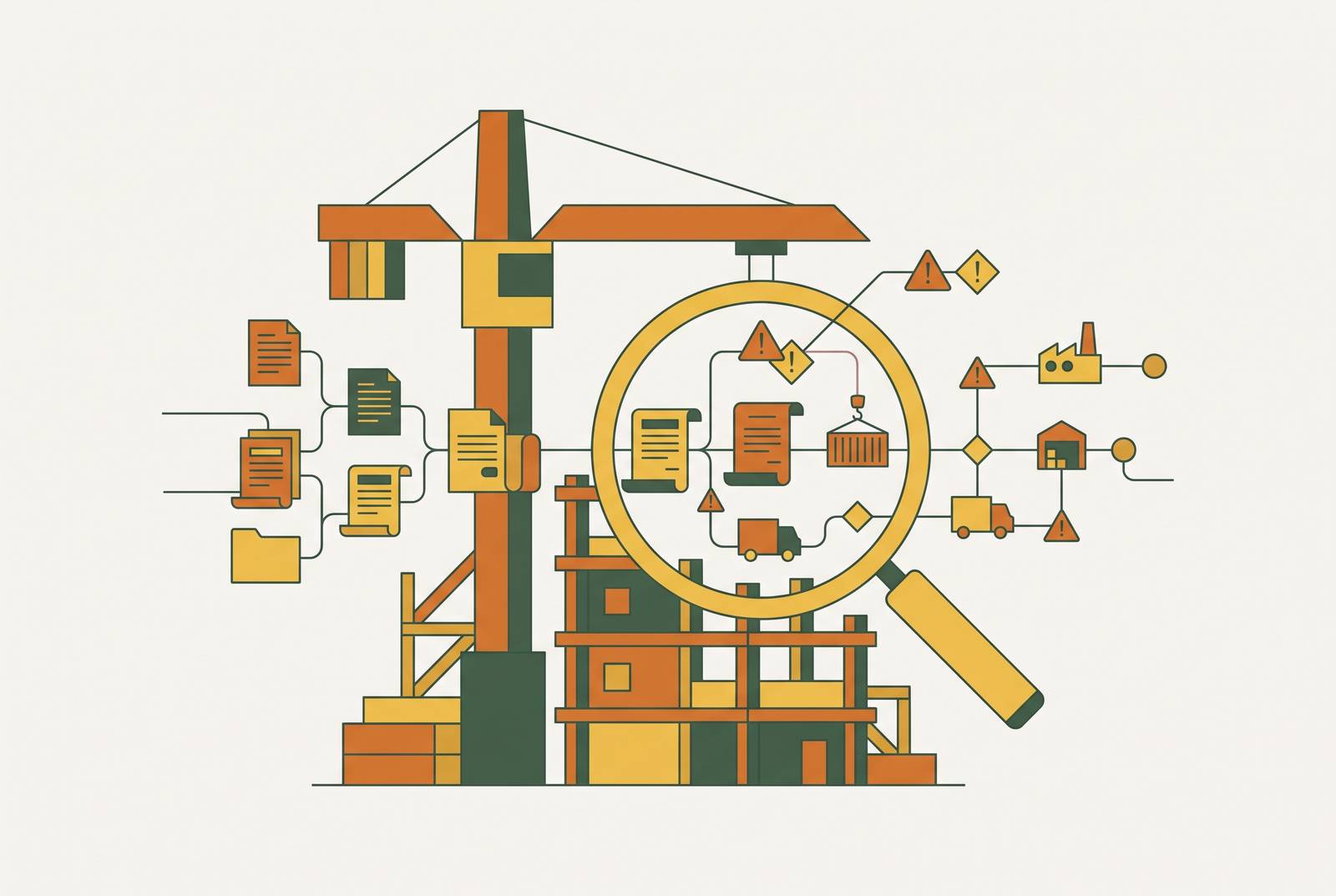
Procurement risk in capital projects rarely appears in the data teams are already watching. It occurs in the space between what a purchase order says and what a vendor has actually agreed to do, and that space is not visible on a dashboard until the delay has already started.
How Procurement Risk in Capital Projects Goes Uncaught
A purchase order status update tells a project team what was ordered and when it is supposed to arrive. It does not tell them whether the vendor has set aside manufacturing capacity to actually hit that date, or whether the freight handoff downstream has been confirmed by anyone. The schedule says the long-lead item will arrive on time because the PO says so, and that's the entire basis for the assumption. No one in the reporting chain is watching whether the vendor has committed real capacity, and no one is tracking whether the logistics handoff has moved from a verbal understanding to a confirmed booking. That's a structural blind spot, built into how procurement status gets reported, not a case of someone failing to check carefully enough.
Field conditions move faster than the paperwork describing them. Progress reporting that depends on manual updates lags real conditions on site, often by two to three weeks, and in practice that means a project manager frequently has no way to catch a schedule slip until it has already turned into a two-week hole in the plan. Each week that passes before the gap gets noticed is a week the gap gets to compound, quietly, before it ever reaches a status meeting.
Part of the reason this persists has to do with where procurement sits in the organization. On most capital projects, procurement is managed at the project level, often without tight integration into the planning work that happens months before contracts are even signed. The people best positioned to catch a mismatch between what's declared and what's actually committed are, by design, not in the room when the risk is first created.
Where procurement risk is seeded in the project lifecycle
By the time a procurement problem becomes visible on the schedule, its root cause is usually weeks or months old. Most of the drivers of procurement delay take hold during project preparation, long before a contract is signed or a purchase order is cut, and that timing changes where any real fix has to aim.
The owner's own preparation process is, more often than contractors or suppliers, where delay causation originates in infrastructure procurement. That point runs against the instinct to look at vendors first when something goes wrong. Supply chain issues, material shortages, delivery failures, and procurement errors make up the single largest category of delay across capital projects, and these failures trace back almost every time to decisions made, or left unmade, while procurement was still being set up.
The clearest illustration is long-lead equipment. When a critical piece of kit shows up late, it doesn't just delay one task. It forces temporary works, partial completions, and return visits from crews who've already moved on, and every one of those return trips drags down productivity for every trade sequenced behind it. Utility and energization coordination deserves specific attention here, because it tends to get buried inside broader delay categories. A single missed utility milestone can hold up testing and turnover for several working days after every other piece of the project is already finished.
None of this is visible yet when the preparation phase is underway. It only becomes visible once the schedule has already absorbed the damage, and that is precisely the problem the next section gets at.
What the schedule does not capture
A project schedule, no matter how detailed, records what the team intends to happen. The risk that eventually causes a delay lives somewhere else, in procurement commitments, coordination handoffs, and vendor states that the schedule assumes are true but never actually checks.
Take a standard P6 baseline. It reflects planned lead times, not confirmed ones. It reflects anticipated approvals, not approvals anyone has actually tracked to completion. It reflects assumed vendor manufacturing capacity, not capacity anyone has verified. They're the structural design of the document itself, built to capture a plan rather than to test whether reality is keeping pace with it.
Workflows across a typical capital project run in parallel but rarely talk to each other. Schedule data often doesn't reflect procurement risk. Meeting notes rarely connect back to the RFIs they were supposed to resolve. Approvals sit buried in email threads. Budget exposure often has no real-time view. These are separate streams of information, each one accurate in its own narrow context, and almost never reconciled into a single picture anyone can act on.
The root cause of a delay has usually been sitting there for weeks before it appears on the schedule. It went unnoticed because no one was watching the specific data that would have revealed it earlier. Utility coordination and energization readiness show the sharpest version of this failure, because these milestones sit at the end of a long chain of dependencies. A gap that was invisible in the procurement data all along turns into a full project hold at the worst possible point in the schedule, right when everything else is supposed to be wrapping up.
Surfacing the Hidden Gap Before It Locks In
The useful role for AI in procurement risk detection is connecting vendor performance signals, approval timelines, logistics patterns, and manufacturing progress into one coherent picture, something no manual process can sustain day after day across hundreds of line items.
EY's analysis of capital project controls draws this distinction directly: AI-enabled project controls analyze patterns, identify anomalies, and flag emerging risks before they affect outcomes, in contrast to conventional reporting systems that mainly describe historical performance after the fact. The practical skill involved is reading across data that lives in different systems and different formats, vendor documents, procurement portals, delivery records, invoice data, and finding the patterns in that combination that no single analyst would catch by reviewing each source on its own.
STRABAG's work with Microsoft Azure and OpenAI gives a concrete example of this in practice. The approach compares an incoming project against the full history of the company's completed projects, using early-phase data to flag where delays, cost overruns, or safety issues are most likely to appear before the project is far enough along for those risks to show up in execution. The value comes specifically from catching the signal early, while there's still time to act on it.
A related but distinct capability belongs at the document level. Platforms built with construction-specific AI can analyze contracts to flag unfavorable terms, scope gaps, and compliance risks, giving procurement teams a clear risk picture before a commitment gets signed. That's a meaningful piece of the puzzle, but it shouldn't be confused with the operational, data-connection problem that sits at the center of procurement risk detection. The two work together: one looks at what's written into the contract, the other watches what's actually happening in the supply chain after the contract takes effect.
Why most organizations are not positioned to deploy AI for procurement risk
The capital projects that need AI-driven procurement risk detection the most tend to be the ones least equipped to use it, because their underlying data is scattered across systems, inconsistent in format, and never integrated in the places where the actual risk lives.
Most procurement leaders say their own data isn't ready for AI. Without one shared, trusted record of who the suppliers are, and without the ability to trace a dollar from spend commitment to purchase order to invoice, AI doesn't bring clarity to that kind of environment. It amplifies the disagreements already built into systems that don't agree with each other to begin with. This is a process and organizational problem: the data needed to surface procurement risk, vendor performance history, approval timelines, manufacturing progress, logistics signals, sits in different systems, owned by different teams, with no shared definition across those teams of what counts as a confirmed commitment.
Agentic AI runs into the identical ceiling. Across enterprise pilots, 88% of agentic AI projects never make it to production, and the main reason is unclear business value combined with inadequate risk controls, built into processes that were never designed to support a system acting on its own. BCG's work on AI procurement transformation backs this up directly, naming people, organizational structure, and process redesign as barriers that matter far more than the technology itself. Making AI work in procurement is mostly process work, not a software rollout.
For capital projects, the implication is specific. Automating a procurement reporting process that already produces inaccurate data doesn't lower risk. It produces the same inaccurate signals, just faster, with more apparent confidence, and with less human scrutiny applied before anyone acts on them.
What has to be rebuilt before AI can reliably detect procurement risk
Before AI can detect procurement risk with any reliability, the underlying process that generates procurement data needs to be rebuilt around a clear, traceable flow: vendor commitment, confirmed delivery, schedule impact. AI trained on top of a fragmented process will detect fragmented signals, not the real risk.
That rebuild starts with a plain audit of how a procurement commitment actually gets made today: who confirms it, in which system, on what timeline, and where that confirmation does, or more often doesn't, connect back to the project schedule. That audit needs to happen before anyone decides what to automate or monitor. The specific failure points include lead times that get declared rather than confirmed, approval timelines that exist only as a trail of emails, vendor commitments that were never tied to actual manufacturing milestones, logistics handoffs agreed to verbally rather than booked, and energization readiness tracked in a separate silo from the procurement chain that actually feeds it.
What this work is building toward is a hybrid model where AI takes on continuous, detailed monitoring of vendor signals and procurement data, and the human procurement capacity that monitoring frees up shifts toward supplier strategy, resilience planning, and the complex negotiations that still need human judgment. BCG's research on this redeployment found that 60% of the human capacity freed up by this kind of automation can move into exactly that kind of strategic work, including AI governance itself.
The right starting point for this kind of project is narrow. Pick one specific procurement workflow that is currently causing the most pain, not a platform strategy or a sweeping transformation roadmap. The first AI-supported process should be running within weeks, not quarters, and it should produce a visible, measurable change in that one workflow before anyone expands the scope. Mastt's work on the $32 million Oakhill College project shows what this looks like applied at the project level: daily forecast tracking, automated visualization of risks before they escalate into problems, and cost and risk discipline built directly into the day-to-day workflow rather than added on top of the reporting process after the fact.
A governance requirement is becoming harder to avoid. Enterprise clients and regulators increasingly want to know not just that AI is monitoring procurement, but why a given system was allowed to act on a particular signal. Procurement AI that can produce an audit trail and evidence to back up its own decisions is the direction the market is heading, and it's a fair bet that this becomes table stakes within a few years.
Tariff Exposure and Price Volatility in Procurement Risk
Price volatility and tariff exposure have raised the cost of every undetected procurement risk, because the gap between a declared lead time and an actual vendor commitment now carries a pricing risk stacked on top of the scheduling risk that was already there.
Construction input costs rose 41.6% between February 2020 and March 2025, and tariff exposure now touches a large majority of contractors. A procurement commitment made on a declared price, without a locked-in, confirmed vendor relationship behind it, now carries delivery risk and repricing risk at the same time, and either one alone can blow up a budget or a schedule. A vendor commitment that would have been a tolerable informality in a stable cost environment becomes a live source of both delay and budget overrun once prices start moving, and the standard progress reports that teams rely on still don't capture either kind of exposure.
The ability to watch vendor performance signals, pricing anomalies, and logistics patterns continuously, instead of waiting on the next progress report to find out what already happened, is worth more now than it would have been in a flatter cost environment. The earlier a team sees the signal, the more options it still has before the commitment locks in and the price or the delivery date becomes fixed. The current build-out of data centers and power infrastructure adds another layer of pressure on top of this: long-lead electrical and utility equipment is under real supply strain, and energization readiness, already one of the most undertracked risks in the whole chain, has become a hard constraint in markets where grid interconnection queues stretch on for months.
The practical point for anyone making procurement decisions right now is straightforward. The process that was good enough in 2022 isn't good enough in 2026. The gap between what gets declared and what gets actually committed hasn't changed shape, but what sits inside that gap now costs a great deal more to miss.