ERP-Native AI Features vs. Dedicated AI Operations Tools
ERP AI handles finance well, but operations need real-time data across disconnected systems.
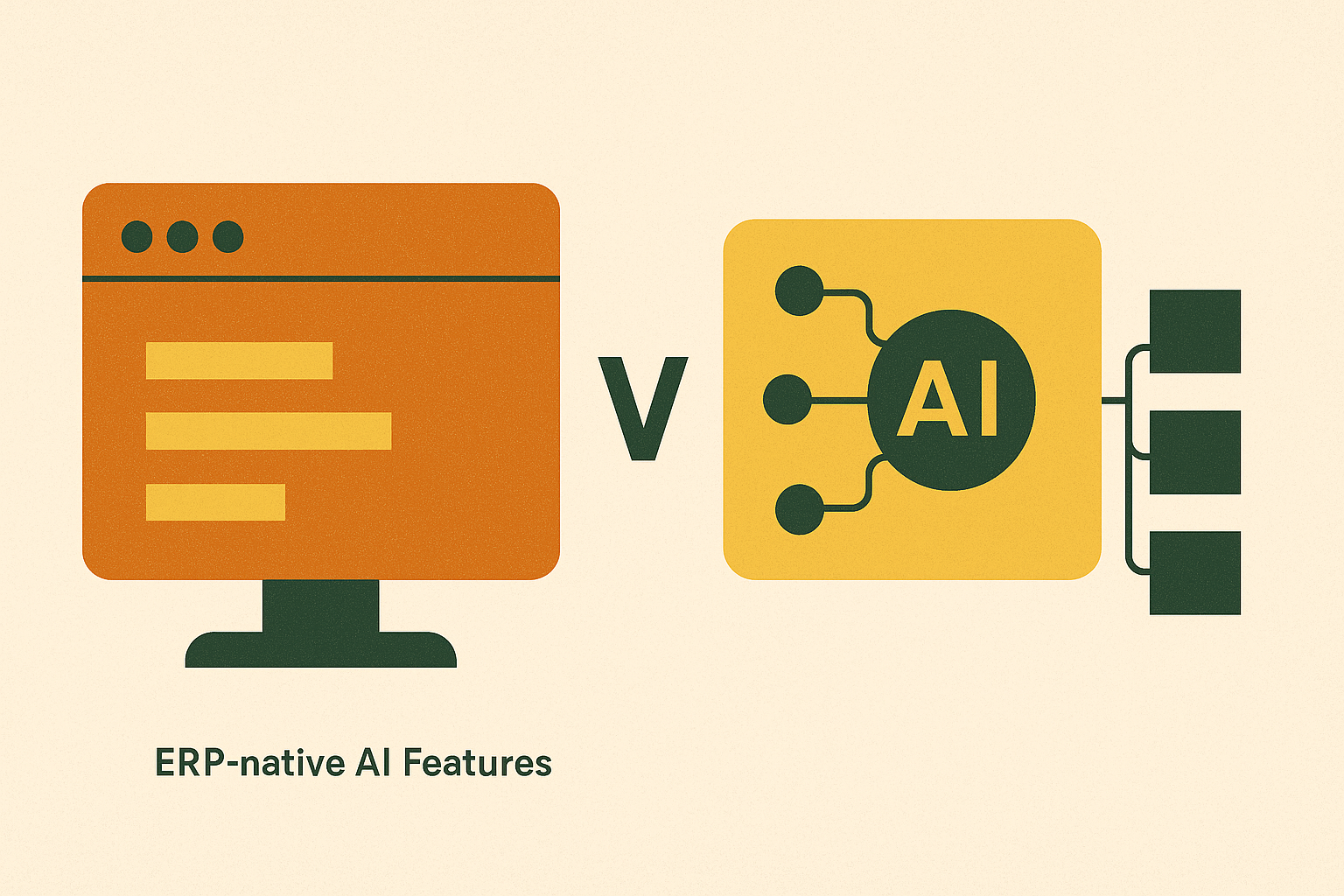
ERP vendors have not built bad AI. They have built AI that serves the system of record, and the system of record was never designed to run a construction site, a distribution network, or a production line in real time. That distinction, not feature quality, is the reason operations teams keep hitting a wall when they try to push ERP-native AI past reporting and into actual operational decision-making.
Why ERP AI features and operational workflows are incompatible
Even the most advanced ERP architecture connects its intelligence to transactions, workflows, business rules, and audit trails, which sounds like what an operations team needs. The catch is what that intelligence has to answer to. An AI-proposed action inside an ERP still has to clear posting rules, approval limits, segregation-of-duties policies, and accounting periods before it can execute. That is a system governing a ledger, not one driving a field operation, and the difference shapes everything downstream.
Traditional and AI-enhanced ERP platforms are built around structured records: database transactions, forms, scheduled jobs, predefined workflows. These systems work well when inputs are known and outcomes are predictable, such as enforcing a purchase approval limit or blocking an invoice that falls outside tolerance. They perform far worse when a problem depends on dozens of variables that change by the hour, which describes most real operational work.
Most ERP systems marketed as AI-powered are legacy platforms with AI bolted onto the surface: a large language model wired to a dashboard, or a chatbot sitting on top of a database that hasn't changed underneath. That is a meaningful distinction from AI-native design, and it matters because the underlying data model never moves. ERP data is built around invoices, purchase orders, inventory balances, and journal entries. Operational work in construction, logistics, manufacturing, and retail runs on contracts, emails, supplier documents, quality reports, site photos, and field notes. A system built to govern the first category has no native way to govern the second.
What ERP-native AI does well
None of this makes ERP-native AI a wasted investment. It delivers real value inside a narrow band of high-volume, rule-demonstrable finance and administration work, and you need to name that band because it's where the genuine strengths live.
Oracle's Payables Agent is a good example of what mature, production-grade ERP AI looks like: it ingests invoices from email, PDF, portals, and EDI, extracts and normalizes the data, matches it against purchase orders and receipts, applies tax and policy checks, and routes the result for approval. NetSuite runs machine-learning demand forecasting built on past sales patterns, anomaly detection across demand planning and financial close, and predictive analytics that include payment date prediction and multivariate forecasting. Microsoft Dynamics 365 with Copilot handles cash flow predictions, it flags late payments based on customer payment history, and it generates reports from plain-language queries. These are refined capabilities that have been running in production for years.
Data quality determines this value: good data produces forecasts worth acting on, and bad data produces confident-sounding nonsense at the same scale, because predictive accuracy depends entirely on the quality and volume of historical data behind it. Companies running legacy systems with decades of accumulated data problems face a cleanup project before any of this predictive capability becomes usable at all, and that cleanup is often larger than the AI deployment itself.
The cross-system constraint that makes ERP AI structurally insufficient for operations
Operations in construction, logistics, manufacturing, and retail span systems that no single ERP touches, and that reach makes ERP-native AI blind to the exact relationships that a project, a shipment, or a production run depends on for success.
Picture a company running one platform for financials, another for CRM, a separate payroll system, and planning that still lives in spreadsheets. The native AI inside any one of those platforms cannot analyze the relationship between sales-pipeline data and cash-flow projections, because it only sees what sits inside its own environment. The same boundary problem occurs across every asset-heavy industry.
In construction, the signals that determine schedule risk, material delivery status, equipment availability, crew readiness, weather, subcontractor coordination, energization readiness, live outside the ERP entirely, scattered across field systems, procurement platforms, BIM tools, and documents that were never structured for a database. ERP AI has no path to synthesize them. In logistics, the variables governing routing, load optimization, and carrier performance sit inside TMS platforms, carrier APIs, weather feeds, and warehouse management systems, all outside the ERP boundary. In manufacturing, a supply chain agent capable of monitoring hundreds of variables and adjusting purchase orders, production schedules, and logistics routing needs continuous access across procurement, production, and logistics systems at the same time, something a single ERP's AI cannot provide by design.
Heavy investment in an ERP's native AI deepens dependency on that one vendor, and it makes any future migration or platform change far more disruptive, because the AI capability and the platform stop being separable. There's a cost dimension to this too: advanced AI modules from major ERP vendors carry add-on licensing that often approaches or exceeds the cost of a purpose-built platform, while staying permanently bounded to that single ERP environment. Operations firms like Terminal Use rebuild processes from the ground up instead of retrofitting AI onto existing ERP data models because of this architectural mismatch. Retrofitting treats the workflow as secondary to the system of record. Rebuilding designs the workflow first and puts the AI agent at its center.
The Gap Between Declared Schedules and Actual Readiness
In mission-critical project delivery, the real danger isn't bad data sitting inside the ERP. The ERP records intent, but the risk that actually threatens a project lives in procurement, coordination, and commissioning data that the system of record never captures.
A P6 schedule or any similar planning tool records what was planned for a given day. The signals that reveal actual risk, a supplier running late, a crew that isn't available, an equipment status change, a failed energization check, exist in field systems, supplier communications, and site reports, none of which the ERP ingests. Vision-based AI tools in construction now track work completed on site autonomously, they compare actual progress against the planned schedule, and they issue deviation alerts. The same tools track material deliveries and equipment availability, so you face less uncertainty over whether resources are actually ready. That kind of real-time synthesis sits outside what ERP AI, bound by its own data model, can perform.
The resequencing example makes the contrast concrete. When a material delivery slips, an AI embedded in the operational workflow can present resequencing options, show the resource impacts, and map the downstream effects on dependent activities, with the general contractor validating those options against field realities. Judgment gets applied exactly where it matters, at the decision point. An ERP, by contrast, generates a delay report only once the slip has already happened. Document AI plays a similar role on the paperwork side: three-way matching across purchase orders, delivery tickets, and invoices is mature and reliable, but its value comes from catching a mismatch before crews mobilize, not from recording the mismatch afterward. Timing is what separates a useful intervention from a historical note.
None of this should be oversold. Scheduling AI in the field is still described as emerging, with high interest but limited deployment, and the honest warning attached to it is that a schedule optimized on paper still has to meet trade availability, weather, and change orders in the real world. Premature certainty about AI-driven schedule optimization is its own failure mode, and any operations leader evaluating these tools should treat that caveat as a sign of a vendor's credibility.
Layering AI onto Existing Operational Processes Produces the Same Failure at Higher Speed
The structural ceiling on ERP AI and the failure pattern in AI augmentation more broadly turn out to be the same problem seen from two angles. Both automate the process that already exists instead of rebuilding it, so a bad process just runs faster and bad outputs scale with it.
Before any of this works, a firm has to figure out where AI can actually reorganize how the work gets done, not just where it can be bolted onto an existing step. Most organizations skip that discovery step and layer AI straight onto workflows that were designed for people doing manual execution. Startups that redesigned their workflows end to end around AI generated substantially more revenue than equally equipped peers who used AI mainly to speed up individual tasks. The tool wasn't the variable. Whether the workflow got rebuilt around it was.
Construction illustrates the belief-versus-readiness gap sharply. A large majority of construction firms report using AI already or planning to increase their investment in it, yet only a small fraction have actually changed how their workflows run. Adoption clusters in low-risk functions like admin and estimating, so higher-risk, field-facing processes like commissioning remain largely untouched, even as scheduling and procurement start to see more deployment. Poor data compounds the problem further: it doesn't just cap how well AI performs, it produces flawed outputs at scale, which makes bad automation worse than no automation. That risk applies equally whether the AI in question is ERP-native or a dedicated tool dropped into a process nobody rebuilt.
The practical test that separates readiness from wishful thinking is straightforward. Audit a candidate use case against three criteria: does it involve high volume, can the rule be demonstrated clearly, and can the outcome be measured. A process that fails those three tests isn't ready for an agent, no matter how much potential it seems to have on paper.
What dedicated AI operations tools do differently
Dedicated AI operations tools sit inside the operational workflow itself, cross system boundaries, and act on real-time signals to serve the operation directly. That's a different architectural premise, not a richer feature set on the same foundation.
The defining trait is continuity: agents that run constantly, monitoring variables across multiple systems at once and making or recommending adjustments within parameters that human operators set in advance. People define the guardrails; the agent handles execution inside them. The AI sits inside the process rather than reporting on it once the process has already happened. Cross-system access is the baseline requirement, not an advanced feature: purpose-built platforms connect natively to multiple ERPs at the same time and generate outputs from live data, without data exports, middleware, or someone manually bridging systems. That's the structural capability that ERP-native AI cannot replicate by design, because it would require the ERP to stop being an ERP.
In construction, this looks like integrating data from materials, equipment, schedule, and field reporting systems to confirm the inputs a crew needs are actually in place before that crew mobilizes, a workflow crossing at least four system types that no ERP governs on its own. In manufacturing and logistics, it looks like agents adjusting purchase orders, production schedules, and routing in real time across procurement, production, and carrier systems simultaneously. The transition from ERP-native AI, which excels at structured, batch-processed tasks like invoice ingestion, to operational AI, which has to respond in real time to dozens of changing variables, requires a different operational architecture altogether, one where the agent works inside the workflow. Firms rebuilding industrial department workflows for construction, logistics, manufacturing, and retail typically start their engagements there.
None of this guarantees success on its own. Enterprise AI agent deployments fail far more often for organizational reasons than technical ones: unclear ownership of the process, integration complexity that nobody planned for, and governance gaps around monitoring what the agent actually does. A dedicated tool with the right architecture still fails if the organization around it hasn't resolved who owns the exception when the agent gets something wrong.
Evaluating Options for AI Operations Deployment in Construction, Logistics, Manufacturing, and Retail
The evaluation has to start with the process, not the platform. The first real test of any provider is whether they audit and rebuild the workflow before deploying an agent into it, or whether they deploy agents into whatever process already exists and call that transformation.
A provider that opens with a platform demo instead of a process audit is signaling the wrong starting point. The conversation should begin with a specific, painful process: where it breaks, who owns the exception when it does, and what the underlying data actually looks like. A technology roadmap is not a substitute for that conversation.
Speed to live is a reasonable proxy for rigor. A first AI-first process should be running within weeks, not quarters. A long timeline usually signals that a provider is building a platform rather than rebuilding a specific process, and that's a different product carrying a different risk profile. Field evidence matters just as much: a provider that can point to deployments inside construction scheduling, procurement, logistics coordination, or manufacturing execution, not just finance automation, is operating in a different domain than an ERP vendor or a general-purpose AI consultancy, even when their marketing sounds similar.
Because operations in construction, logistics, manufacturing, and retail span systems that no single ERP can see, the real constraint is the architectural inability to synthesize signals across those systems, and that constraint has to be solved before any agent can run an end-to-end workflow rather than a fragment of one. Terminal Use works from that premise directly: every engagement opens with a process audit, where the client shows how the process runs today and where it hurts, before any decision gets made about what to rebuild first. The team's background includes rebuilding operations for some of the largest engineering, procurement, and construction firms in the country, along with companies running medical billing at national scale, and the firm positions itself as an operational transformation partner, with a first live process targeted within weeks.
Other paths exist and serve real purposes. Staying inside an ERP's native AI roadmap makes sense for finance and administrative functions that are already high-volume and rule-based, where the vendor's own tools, Oracle's Payables Agent among them, are mature and well-suited to the task. General AI consultancies can help you think through where AI fits into a broader strategy. Neither approach, on its own, resolves the cross-system constraint that defines operational work in construction, logistics, manufacturing, and retail. For operations leaders whose risk sits in the field rather than in the ledger, the evaluation has to weigh which approach actually works inside the workflow, not just alongside it.