Field Data Capture Tools and Their Integration With Construction Schedules
Real-time field data closes the lag between what happens on site and what decision-makers see.
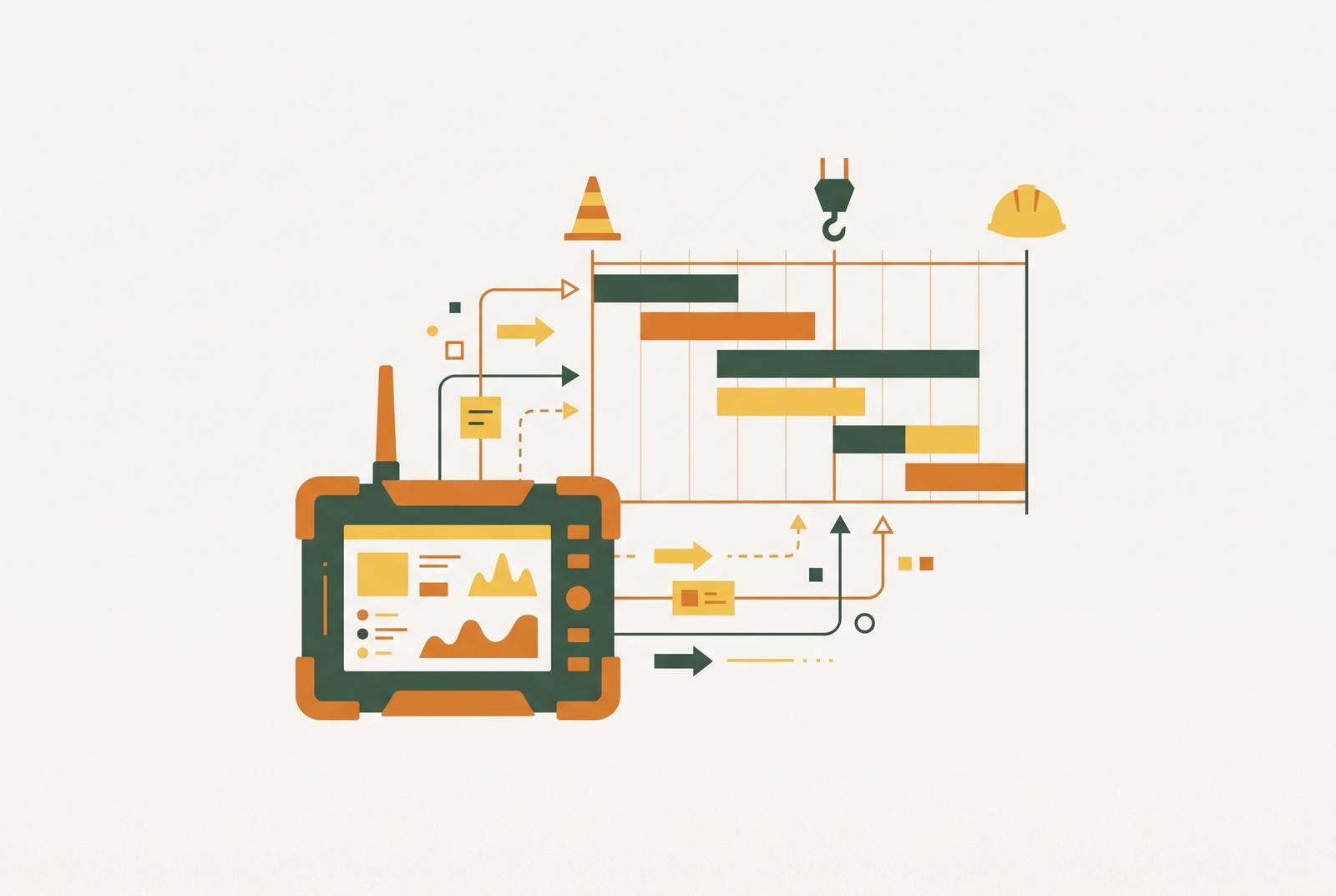
A delivery arrives on a Tuesday morning. The crew is idled for three hours. A procurement decision gets made that afternoon based on a schedule that still shows the material as pending. Field data capture tools matter not because they digitize paperwork, but because they close the structural lag between when field events happen and when they become visible in the schedule.
The core problem in construction schedule management is not bad planning. It is that field events generate cost and schedule consequences before anyone with authority to act can see them. A delivery, an idle crew, a missed coordination point all happen in real time. Each enters the schedule only after someone documents it, that document is processed, and a planner updates the plan.
The resulting lag is structural, not accidental. It is built into every reporting chain that relies on human-initiated documentation steps. Someone has to notice the event, decide it warrants recording, capture it in some form, transmit that form, and then wait for someone else to interpret and enter it. Each step introduces delay, and the delay compounds across the chain.
The gap between a cost event occurring on site and that event becoming visible in the commercial or financial system can be measured in days, not hours. During that lag, decisions get made on stale data. A project manager expedites the wrong crew. An approval gets held that is not blocking anything. A procurement gets released that should have been held back. The schedule is not a live picture of the job. It is a lagging indicator of decisions that were already made, often under pressure, with incomplete information.
How the lag compounds when documentation stays manual
Manual documentation methods do not simply delay data. They systematically lose context, making the delayed record less useful than the original field observation. Taking photos, jotting notes, and sending follow-up emails after a site walk are the dominant field documentation methods on most sites. None of them reliably captures where an issue occurred, how it relates to the drawings, or what changed since the last update.
Variations go unrecorded because site teams have no connected capture process for scope changes. Plant and labor costs arrive as surprises because weekly paper-based reporting conceals idle time until invoices land. By the time the office sees the numbers, corrective action is no longer possible. The window for intervention has closed.
A peer-reviewed study of a major North American metro-line extension, published in the journal Infrastructures, found that workflows described as automated were, in practice, still largely manual. Subcontractors received requests by email, prepared documents, and returned them by email. The received file was then manually processed before it was uploaded to the common data environment. All subcontractor communication happened outside official platforms, without systematic archiving or guaranteed traceability.
The critical implication is that the declared workflow and the practiced workflow are routinely different. Process audits are the only way to see which one is actually running. This is not a small-firm problem. It appeared in a well-resourced consortium on a major infrastructure project, where the stakes and the oversight should have been highest.
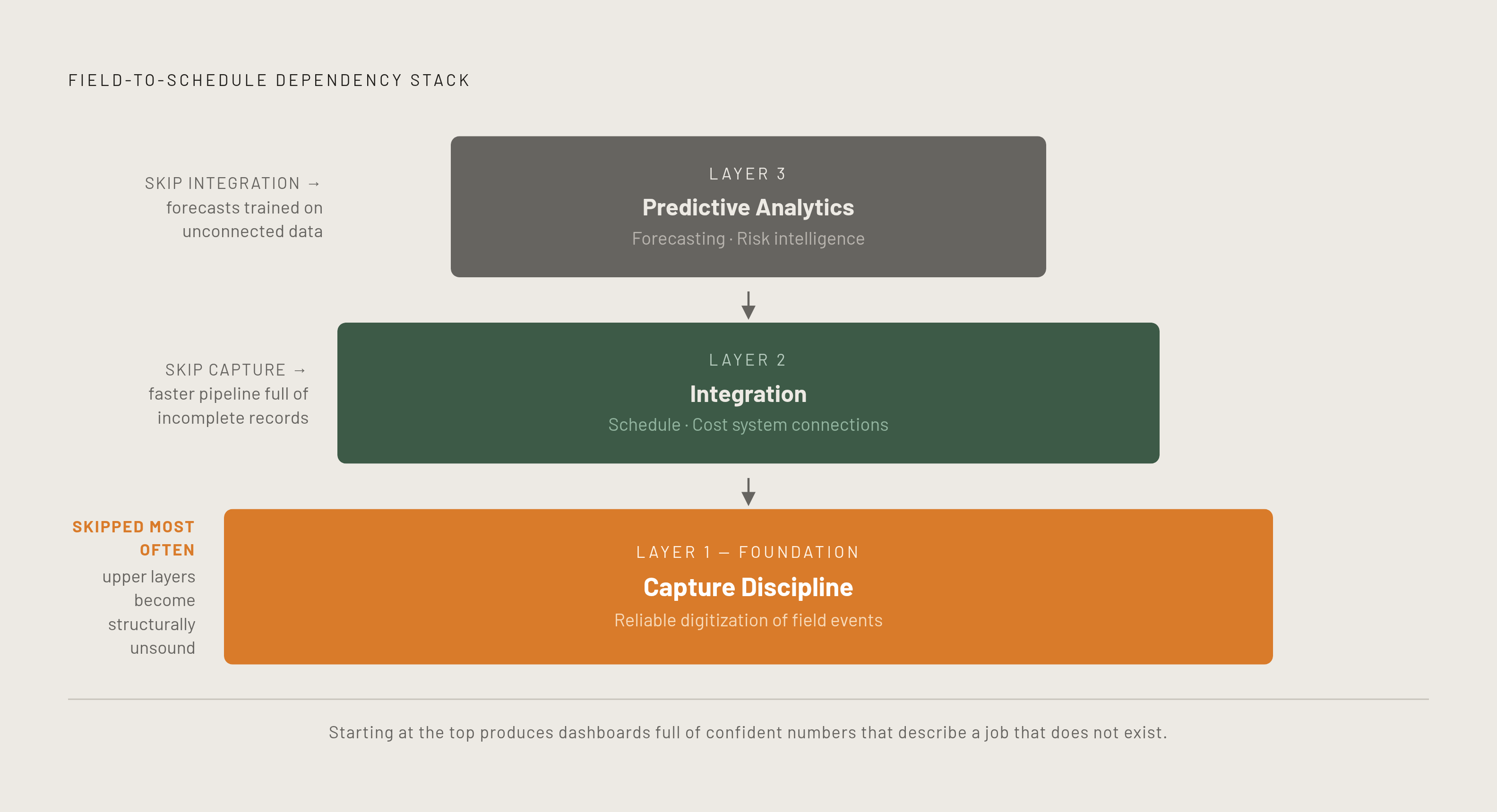
Automating a process that is already broken at the documentation layer does not close the lag. It accelerates the delivery of unreliable data. A faster pipeline full of incomplete records lets bad information reach decision-makers sooner, where it does more damage than if it had arrived late.
What schedule integration actually needs to accomplish before it can work
To close the visibility gap, field conditions must drive schedule status, not the other way around. That demands a specific, rarely-met set of data anchors before integration can be meaningful. A field capture record is only schedulable if it carries four anchors: job, location, cost code, and source. Without these, a record reaches the system but cannot be acted on without manual reconstruction of context. The manual reconstruction reintroduces the very lag the integration was meant to eliminate.
The capture layer must preserve the drawing revision, photo, form, RFI, daily-log date, cost code, and the person responsible for validating it. These are not administrative niceties. They are what makes the record auditable when a dispute arises. An integration that drops any of these elements produces a system that functions smoothly in normal operation but collapses precisely when it is tested.
Field capture and schedule action must be kept in distinct lanes. A form can document a delivery, crew hours, a safety observation, or an RFI question. It cannot decide whether a change is approved, whether a cost belongs in the committed budget, or whether work is acceptable. Those decisions remain with people who hold project, commercial, and financial authority. The capture tool records what happened. The authority structure decides what it means.
OCR and AI extraction tools can propose a cost code, vendor, quantity, or date from a ticket. A superintendent, PM, or cost owner must validate what is posted to the system of record. Treating OCR output as a confirmed entry is a governance failure, not a technology failure. The algorithm proposes. The accountable person disposes.
Forecasting tools are only as reliable as the data fed into them. A project where field teams do not log actual progress, where purchase orders arrive late, and where incidents go unreported will produce unreliable forecasts regardless of the sophistication of the scheduling engine sitting on top. The quality ceiling for any predictive system is set by the capture discipline beneath it.
How different tool categories close different parts of the gap
The field data capture ecosystem has stratified into distinct functional layers, and each one closes a different slice of the declared-versus-actual gap. No single tool closes all of it. Understanding which layer addresses which failure mode is the difference between buying a capability and buying a subscription.
Computer vision progress detection closes the gap between physical installation and schedule status, with no manual tagging step. DroneDeploy's Progress AI detects work across more than 80 trade types from visual captures, so you get structured progress reports within minutes of a site walk or flight. AI Clearing supports schedule integration including Primavera P6, and combines aerial and ground-level imagery for infrastructure and civil teams working without a BIM model. The mechanism is straightforward: when AI recognizes that framing is complete on a floor, it updates the corresponding schedule line item without a form being filled. Field conditions drive the schedule rather than an estimator's judgment.
Schedule-connected lookahead platforms close the gap between the master schedule and weekly field execution. Outbuild connects master schedules, lookahead plans, weekly work plans, and field input in one platform. Roadblocks surface automatically and schedule impacts become visible before they compound. The value is not in the schedule itself but in the connective tissue between the plan and the people executing it.
Field-first capture tools address the documentation layer directly. Fieldwire is built for teams needing mobile and offline forms, plan context, photo attachments, task coordination, and a straightforward handoff to the office. Its Android and iOS apps can view downloaded project content and add new content while offline, syncing when the device reconnects. Autodesk Forma, formerly Autodesk Construction Cloud, centralizes construction workflows in one place: sheets, files, 3D models, RFIs, schedule, and forms. Field teams and office teams work from the same record, online or offline, as documented in Autodesk's 2026 construction apps overview.
Predictive schedule intelligence closes the gap between current status and forward-looking risk. These tools are downstream consumers of field data. Their output quality is bounded entirely by the capture quality upstream. Feed a predictive engine incomplete records, and it produces confident-looking forecasts built on sand.
The integration gap that persists is that most capture tools focus on capture and reporting. Native two-way schedule integration remains uncommon. AI systems that operate downstream, analyzing data only after it has been entered into a platform, are inherently limited: they rely on second-hand data, have limited control over data quality, and do not capture the workflow data needed to improve the system over time.
What the field record must carry to survive a compliance audit or a dispute
An incomplete or poorly anchored field record does not just produce a bad forecast. It creates exposure at precisely the moments when the record is most needed: audits, disputes, handovers, and insurance transitions. The schedule consequence is only the first-order effect. The second-order effect is financial and legal.
A photo by itself does not establish installation quality, entitlement, progress percentage, or cost responsibility. It is context, not evidence, unless it is attached to a specific project, location, form, drawing revision, and capture timestamp, with the submitter or approver identified. A dispute that turns on whether work was complete on a given date cannot be resolved by a timestamp-less photo in someone's camera roll. It requires the full anchor chain.
Design decisions made late compress procurement and installation windows. Out-of-sequence work introduces quality and safety risk. Documentation that lags behind reality fuels disputes and claims. These are not independent failure modes but a single compounding chain that begins with the visibility gap. The same lag that causes an idle crew on Tuesday becomes the unreconciled variation claim six months later, and the insurance dispute a year after that. Closing the gap early is not an efficiency measure. It is risk management.
Why most integrations fail to deliver durable schedule visibility
The dominant reason field data capture integrations fail is not technical immaturity but organizational reality: declared workflows diverge from practiced workflows, governance over data quality is absent, and the capture layer is treated as a reporting formality rather than the foundation of schedule control. The pattern documented in the metro-line study applies broadly. Processes described as integrated are, in practice, only partially implemented, or do not exist at all. The gap between the system diagram and the actual daily behavior of field teams is the real risk.
Enterprise AI agent pilots face the same ceiling. As of March 2026, only 11 to 14 percent of enterprise AI agent pilots have reached production at scale, and the failure modes are primarily organizational. Governance breakdowns, data quality and readiness gaps, absence of evaluation and monitoring infrastructure, and integration complexity all rank above technical limitations. The technology is not the constraint. The organization is.
A structurally reliable field-to-schedule integration requires three things. First, a defined data contract for every capture type before any form is built. Second, clear approval routing by record type, distinguishing routine documentation from budget-impacting, schedule-impacting, or safety-critical entries. Third, an authoritative system of record that does not allow a capture tool to silently rewrite a budget or certify progress.
The right starting point for any integration program is not a platform selection but a process audit. The audit shows exactly how the field documentation process runs today: where it hurts, where handoffs break, which steps are declared automated but are actually manual. Only then does the question of what to rebuild first have an answer grounded in evidence.
Buying a reporting layer before field or cost data is reliably digitized adds a subscription with nothing to automate. The correct sequence is capture discipline first, integration second, predictive analytics third. Each layer depends on the one beneath it. Starting at the top produces dashboards full of confident numbers that describe a job that does not exist.