Evaluating AI Vendors Without a Platform Commitment in Asset-Heavy Operations
A three-layer diagnostic finds the real constraint before you pick a vendor.

AI operational improvement in asset-heavy industries can start with one broken process, without an enterprise platform commitment or a complete digital roadmap. The first step is to identify whether that process lacks trustworthy data, a suitable model, or a workflow that can act on its output. Vendor evaluation should then target that constraint, rather than let a platform’s capabilities define the problem.
Why asset-heavy operations keep buying the wrong AI platform
A scheduling AI bought to improve project predictability can have nothing trustworthy to run on. If the schedule records intended progress rather than actual execution, the purchase has addressed forecasting capability while leaving the underlying constraint untouched. The vendor need not be deficient for the investment to disappoint. The error happened before the product comparison began.
This is platform-first selection, and asset-heavy operations are particularly exposed to it. Construction, manufacturing, and logistics combine fragmented operational technology data with complex scheduling and procurement workflows. They also require decisions to become physical actions. An insight alone does not complete the job. A platform may connect industrial data, supply domain models, or embed decisions in enterprise workflows, but those capabilities are not interchangeable.
Model breadth contributes little when the operation cannot consistently identify an asset across its source systems. A strong data platform also cannot fill in for a missing failure-mode library. Starting with vendors encourages the organization to solve the problem a product addresses, rather than establish which problem prevents better performance.
How the four platform categories differ in what they actually deliver
The four capability categories show what each type of platform does without ranking them. Data and context platforms structure fragmented operational, engineering, and IT information so that assets become queryable before models are applied. Cognite Data Fusion organizes time-series, events, documents, visual streams, and engineering models around an industrial knowledge graph. Its relevance is greatest where engineering context is as important as telemetry. The evaluation burden includes the work required to populate that context beyond the first site.
OT data standardization platforms tackle a different problem with the data. Their emphasis is repeatability across factories, using reusable data models and template-based rollout rather than repeating the integration project at each plant. Litmus fits this category for manufacturers and supports computer vision acceleration and locally hosted small language models for air-gapped plants. A buyer seeking packaged applications immediately available for use has a different requirement from one seeking consistent OT data across sites.
Packaged model and application platforms have models and applications built for known industrial problems. Their value is faster insight from relevant models, rather than maximum flexibility in data infrastructure. Sight Machine connects and analyzes plant-floor data to support improvements in OEE, scrap, and throughput. Its 2026 expansion into autonomous AI agent capabilities also illustrates how an application can move from surfacing insights toward acting within defined parameters. That extension makes execution controls part of its evaluation.
Enterprise suite embeddings place AI within existing business workflows. For SAP, Oracle, Microsoft, and Infor, the installed suite is usually more decisive than a standalone comparison of AI strength. IFS.ai embeds industrial AI in IFS Cloud across ERP, asset management, and field service on one data model. This category addresses the connection between detection and action. It is therefore relevant when the missing capability sits in workflow execution.
The three-layer diagnostic that should precede any vendor conversation
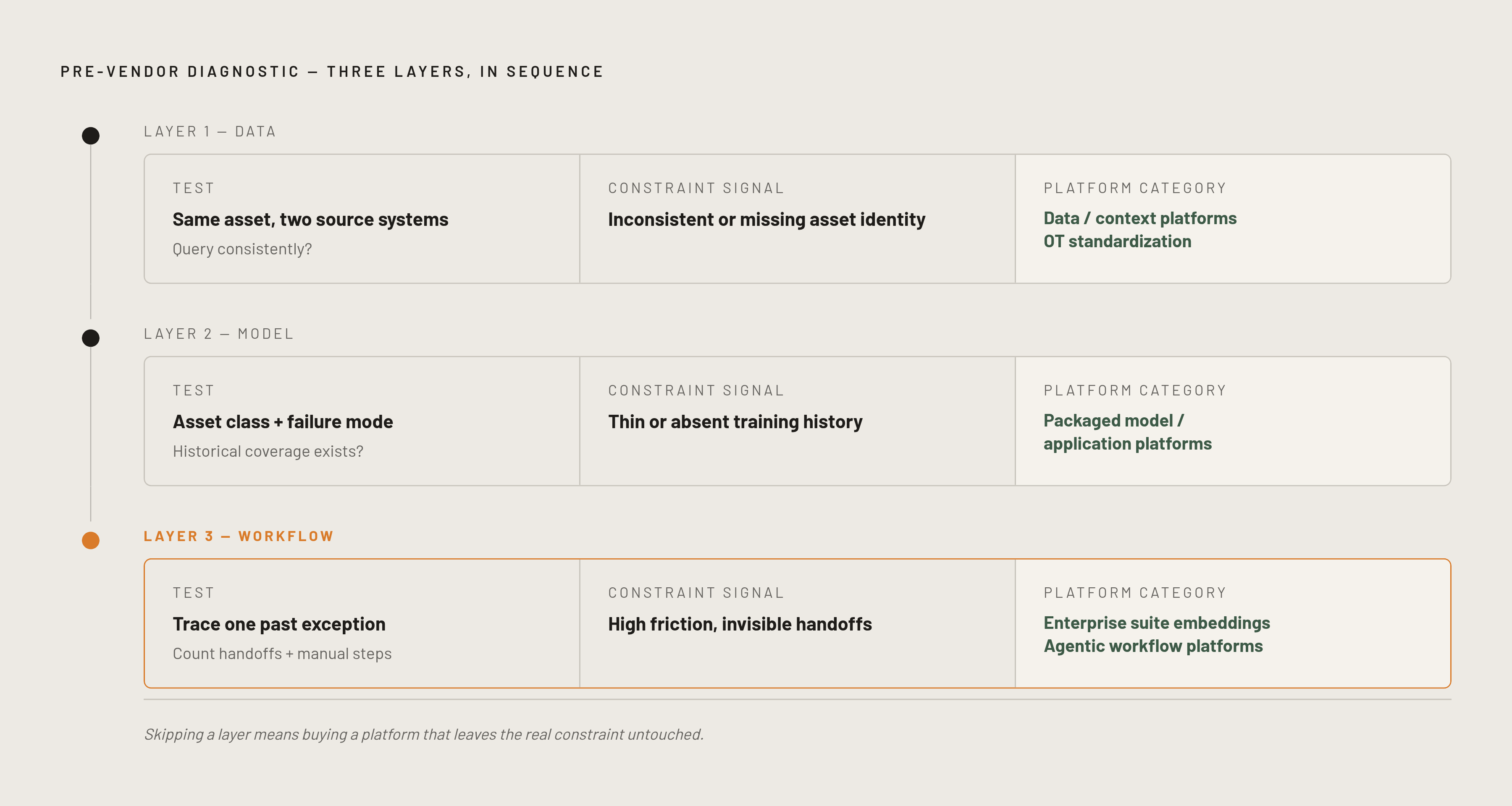
The diagnostic should begin with operating evidence. Documented approvals, reconciliations, and controls may describe a workflow that people routinely bypass. To locate the constraint, examine whether the data supports a trustworthy answer, whether a suitable model exists, and whether the operation can act on the result. Each layer requires a different test. The output is a constraint profile.
At the data layer, test whether the same asset can be queried consistently across two source systems. Differences in asset identity, metric definitions, or records show that the data is not ready, even before anyone looks at model performance. Other indicators include disconnected engineering documents and telemetry, inconsistent tag names between sites, and duplicated or mislabeled MRO inventory. Having data is not the same as having context. A constraint here points toward data and context platforms, or OT standardization where repeatable plant integration is the central need.
At the model layer, establish whether the target asset class and failure mode have relevant historical coverage. An operation may have structured data but no labeled examples or in-house machine-learning skills. Packaged models become relevant when known failure modes and time-to-first-insight outweigh customization. Uptake illustrates this distinction for mining, rail, and heavy construction involving large Caterpillar engines or locomotives, where a pre-existing failure-mode library provides the value. Later talks with vendors should check training provenance, including which real past cases and asset classes the training covered.
At the workflow layer, trace a past exception from its first signal to resolution. Count the handoffs, find the steps done by hand, and check where delays built up. If decisions still lag despite adequate data and model coverage, the constraint points toward enterprise suite embeddings or agentic workflow platforms. However, where approvals are formalities or controls are bypassed, the diagnostic may reveal a need for workflow redesign before any software evaluation.
What production failure data reveals about skipping the diagnostic
The production failure patterns documented in 2026 show why model quality is an incomplete explanation of agent failure. An agent that guesses a metric definition can return a confident answer that conflicts with official reports because no governed definition exists. That is a data-layer gap. The cross-system consistency test would show that a shared definition was missing before the agent went live. Improving the model alone would leave that ambiguity unresolved.
Other failures reveal missing workflow boundaries around uncertain information. An HR onboarding agent that sent a welcome email to a candidate who had not accepted an offer hallucinated the acceptance status. Although this is a back-office example, it separates two evaluation questions that also apply to physical operations. Was the status trustworthy, and was the action appropriately controlled? The data and workflow checks address different parts of that failure.
Governance extends the workflow test beyond business approvals. The CSA/Oasis Security January 2026 press release reports that a large majority of respondents lack confidence in legacy identity and access management for AI and non-human identity risks. It also reports that most organizations lack formally adopted policies for creating or removing AI identities. Similarly, an agent that runs for hours and consumes hundreds of dollars in API calls during an overnight run exposes the absence of defined intervention points.
How the diagnostic plays out in construction scheduling and procurement
Only a small share of baseline schedules meet high-quality standards, and an even smaller share keep that quality through to the end of the project. SmartPM CEO Michael Pink stated at ENR FutureTech 2026, “Everyone's excited about AI. But if we don't get serious about improving schedule data first, AI will just automate bad decisions faster”. The distinction is between a declared plan and an operational record. A model working from intent cannot be assumed to represent execution.
The diagnostic should establish what the historical schedule data actually describes. AI-enabled scheduling can build scenarios from lessons learned, test sequencing options, forecast risk, and suggest recovery plans as conditions change. Those uses require evidence of what happened on past projects. A ready workflow enables people to act on a warning in time to choose a recovery plan.
Procurement exposes a more granular information gap. A recorded lead time can fail to reflect its least visible sub-component, leaving both human review and an AI using the same record blind to the cause of delay. Faster processing does not repair that omission. Before assessing procurement AI, the diagnostic should check whether the system records sub-component lead times or stops at top-level purchase-order items. The useful capability is visibility at the level where the risk originates.
These two cases locate different breaks in the operating record. The scheduling check would show whether past data records what actually happened, while the procurement check would show whether lead-time data covers the relevant sub-components. The workflow check would then examine how either risk reaches a decision. Each begins with evidence that the available information and the response process can support the intended use.
The gap between declared AI adoption and actual workflow integration in asset-heavy sectors
Readiness can be overstated on both sides of the evaluation. A vendor’s announcement may describe future capability, while a buyer’s process documentation may describe controls that are not effective in practice. Neither is evidence of current operating performance. The distortions have different origins but produce the same risk, which is a gap discovered only after deployment. Evaluation therefore needs to distinguish planned capability from available capability, and designed process from actual process.
AVEVA’s official press release says a major CONNECT release is due in Q1 2027 and will include an industrial knowledge graph filled using a twin builder that uses agentic AI. A roadmap can be credible without meeting an earlier deployment requirement. The same distinction applies to an agent demonstrated in a controlled environment but not yet running against comparable operational data and constraints.
On the buyer side, construction AI adoption is concentrated in office, administrative, and estimating tasks, while scheduling remains largely unaddressed. A majority of contractors overall report no plans to adopt AI for scheduling. This pattern is consistent with a workflow-readiness gap. Organizations can deploy more readily where information is structured and the process is already orderly, while the highest-value operating problems remain difficult to integrate. Declared adoption consequently says little about whether AI participates in consequential project decisions.
The appropriate buyer-side test is an audit of exceptions. Overrides, manual interventions, and offline workarounds reveal where operating practice departs from documented design. An approval may exist without meaningful review, and a reconciliation may occur without investigation of differences. Exposing them makes the constraint profile an honest account of readiness.
Running the vendor evaluation after the diagnostic is complete
Once the constraint profile exists, the vendor conversation can begin with a specific operational gap. The evaluation should ask how the platform resolves that gap before moving to feature demonstrations. A vendor demonstrates fit by explaining how its platform resolves the gap, keeping the comparison within the relevant capability category.
For a data constraint, the decisive criteria include knowledge graph population effort and repeatability at the second and third site. For a model constraint, they include training provenance for the target failure mode and operational environment. For a workflow constraint, they include intervention points, governance controls, and production use in comparable operations. The categories require different evidence of suitability. A common feature score would obscure precisely the distinctions the diagnostic was designed to expose.
The practical evaluation should test data assumptions before model claims, using a sample of the organization’s actual data. It should also require a live customer reference using the relevant capability in a comparable asset class. A back-office reference does not establish suitability for construction, manufacturing, or logistics, where data conditions, failure modes, and execution workflows differ. A capability planned for Q1 2027 cannot satisfy a deployment scoped for Q3 2026.
For some organizations, however, the constraint profile will make vendor evaluation premature. If the binding constraint is a broken workflow, automating it can accelerate the failure. The required sequence is to redesign the workflow, establish the operating evidence it produces, and then evaluate platforms against that new structure. Begin with a process audit to establish whether the operation is ready for AI to participate at all.